Wednesday, January 23, 2019

Otherness in African Cosmology

By Biko Agozino

African’s have always seen the world as multicultural and interdependent. The other is not to be killed or eliminated without harming the self. Chinua Achebe captures this notion with his Igbo saying that when one thing stands, something else stands beside it. One tree does not make a forest. The Igbo take this saying beyond the plant kingdom to say that the eagle should perch and the kite should perch, if one does not want the other to perch, it should show the other where to perch because there are many branches and many trees in the forest. The Igbo also say that there should be life for the fish and life for the river. They also say that all heads are equal and that the Igbo know no king, Igbo ama eze. 

This democratic principle was relatively contradicted by discrimination against women in the inheritance of property and by the divisions of some Igbo communities into Amala or the free-born and those who descended from Ohu (slaves) or from Osu (dedicated to the worship of shrines) beginning with the slave raids. However, the Igbo have used cosmopolitanism to combat such discriminations through equal educational opportunities. Nobody refuses to go to school, hospital, court, church, bank, or to take public transportation, or to watch football matches and Nollywood movies or to listen to music simply because any of the officials came from the prejudicial backgrounds that Azikiwe outlawed in the 1950s. Poor Ghanaians still dedicate their daughters as shrine wives to pay off debts. Soyinka credited Africans with exemplary religious tolerance because Africans never wage war to promote their religions. He also observed that the Igbo are admirable because they have never tried to invade and conquer their neighbors in order to build kingdoms or empires.

The earliest awareness of otherness in African worldview was the emergence of gender differences which demonstrated that men and women are the others of one another to be cherished and protected rather than to be combated and eliminated. Children came along as beloved others, other families emerged, other communities, other languages, other religions, other people’s property, rich people and poor people, insane people and sane people, our people and foreigners, good people and evil ones, the living and the ancestors.

Albinism became a marker for otherness probably with the arrival of Europeans in Africa. Albinos are sometimes referred to jokingly as White people. Perhaps because power and wealth were associated with the colonizers, some ritualists believed that using the body parts of an Albino to make money medicine will bring wealth and fortune to individuals. As a result, many Albinos are killed in different parts of Africa for ritual. Whiteness seduced many others into skin-bleaching and Fela Kuti criticized that with the song, 'Yellow Fever'. Ngugi portrayed this sickness in The Wizard of the Crow with the story of how the elites desired whiteness and how this drove them insane enough to imagine that there is a dollar tree where money grows to be plucked but female freedom fighters campaigned for a better society.

Arab settlers in North and East Africa also developed concepts of light-skinned supremacy in Africa but with emphasis on religion as the marker of insiders and otherness, believers and infidels. Colorism is still dominant here because Black Africans who are Muslims continue to be discriminated against by their fellow lighter skinned Muslims who claim Arabic descent as far south as Somalia.

The introduction of whiteness as a mark of privilege by Europeans also dominated Arabs and Asians in Africa who were treated as if they were dark-skinned compared to Europeans. In South Africa, this evolved into the system of apartheid which unjustly deprived the African majority of rights and presumed that they belonged to other homelands that were separate from the white dominated state. The African majority and their allies insisted that the country belongs to all who live in it.

The concept of Ubuntu or the bundle of humanity is used by Desmond Tutu to capture the African philosophy that I am because we are human as opposed to the Cartesian, I think, therefore I am. According to Tutu, everyone has something for which they should ask to be forgiven and everyone deserves to be forgiven something because there is nothing that is unforgivable. 

Achebe captures this principle of Ubuntu with the Igbo celebratory art form of Mbari through which the entire community comes together to build a miniature mud hut and populate it with the representatives of the community and with the foreigners in their midst as a tolerant prayer for protection from the ancestors and the gods also represented under one roof, following the principle that the sun shines on all without discrimination. 

Martin Luther King Jr. used the metaphor of the World House repeatedly to emphasize that people of African descent regard everyone as the children of one God to the extent that we say that injustice anywhere is a threat to justice everywhere and so white-supremacy is a threat to all. Rasta refer to such as One Love for all, not just for some.

Other forms of otherness were introduced into Africa by the colonizers in the form of homophobia whereas Africans did not give a damn about who people loved or how they showed the love until European colonizers outlawed homosexuality. The first military coup in Nigeria in 1966 announced that, in addition to fighting corruption, 'homosexuals will be shot'. Major Gideon Orkar echoed this in his April 1990 abortive regional coup announcement when he said that he was out to overthrow a '... corrupt ... homo-sexuality-centered ... administration...' Of the estimated 3.1 million people killed in the genocidal aftermath of the coup, none has been identified as a homosexual, showing that homophobia promotes violence that affects the whole society. Most people did not even know that homosexuality may have been a problem in the military perhaps because the British officers used it to humiliate the African recruits in order to dominate them. Long after the Europeans who imposed both the death penalty and the homophobic laws on Africa abolished both in Europe, the Africans are hysterically retaining such barbaric laws in Africa contrary to the tolerant culture of our ancestors.

No African society banned homosexuality before the colonization of Africa because Africans were more interested in the abilities of individuals to serve their communities and not the ways that consenting adults loved one another in the privacy of their homes. No African military ever had a Don’t Ask Don’t Tell rule for joining the military and no African society ever made a law called the Defense of Marriage Act. Africans always knew that some men liked to dress like women to perform the spirits of female ancestors in Agbomma or Gelede masquerades, for instance. 

Today, dressing like a woman in parts of Nigeria could get a man stoned to death under Islamic law while same-sex couples could be sentenced to 10 years in prison if convicted under the Nigerian criminal code. Critics point out that this is ridiculous given that the military have yet to defeat the Boko Haram militants who kidnap school girls in the busloads in a country that ranks first with the proportion of children out of school and with low human development index.

Similarly, Africans believed that there were people who had the powers of witchcraft but Africans did not go hunting for them to kill them until Europeans came with their interpretation of Christianity to emphasize exorcism or the killing of the other. In medieval Europe, an estimated 9 million people were killed, and most of the victims were women, on the suspicion that they were witches. No such genocidal records existed in Africa in precolonial times but today poor unemployed youth in South Africa and Tanzania often attack and kill poor old grannies on suspicion that they are the ones who use witchcraft to make jobs disappear or they blame it on those Africans who are attacked because their languages are said to sound incomprehensibly like Makwerekwere. In Nigeria, some parents are encouraged by fake pastors to drive six inch nails into the heads of their children because they were suspected to be witches who prevented their parents from becoming wealthy.

In Renascent Africa, Nnamdi Azikiwe (1937) called on Africans to abandon superstitious beliefs and adopt the scientific methods in healthcare and in the struggle for the restoration of independence. Two years later, Obafemi Awolowo published a rebuttal in a Liverpool-based magazine to say that Africans can use Juju as a science with which to kill their enemies from a remote distance by simply saying their names three times. The colonizers must have been shaking in their boots except that the African Juju only killed fellow Africans. For this reason, Fanon stated that the African was more afraid of the powers of ghosts than the powers of the corrupt police that could be bribed. Today, even professors of physics side with Awolowo against Azikiwe in the debate over the efficacy of the scientific method versus Juju. A Nigerian military dictator, Obasanjo, once called for Africans to use Juju to fight against apartheid.

One of the most dangerous otherness promoted by the divide and conquer strategies of Europeans is ethnicity which the Europeans wrongly called tribalism. According to Rodney, to call the genocide against the Igbo in Nigeria a tribal war would be to call Shell BP, the Labour Party Government in the UK, and even the Soviet Union, African tribes because they orchestrated the killing of the Igbo who led the struggle for the restoration of independence in Nigeria. Rodney added that there was no record of the Christianized neighbors of the Christianized Igbo committing genocide against them prior to colonialism. 

The solution is Nkrumah's United Republic of African States with the right to travel, work, and run for office anywhere while relying on federal might to stop oppressive otherness and to empower Africans with the scientific methods advocated by Azikiwe.

Tuesday, December 25, 2018

Asian Women Attack Adichie Unfairly

By Biko Agozino

Chimamanda Ngozi Adichie isn't quite the champion of feminism you think – here's why | The Independent

A sister forwarded the above critique to me today without comment. I guess that she sent it to me because we had debated a similar critique of Adichie from another Asian woman that she agreed with and I disagreed with but we agreed to disagree on that one. I guess that we may also agree to disagree on this one given my response below:

Happy Sharpe Revolution in Jamaica Anniversary Day,

The young lady wrote very well as a fan of Adichie. I am also a fan and I have been critical in a friendly way as you can see in some of my blog posts republished by Pambazuka News. See https://massliteracy.blogspot.com/2015/02/explaining-success-of-white-man-in.html and see also https://massliteracy.blogspot.com/2013/05/adichies-americadabra.html 

The jealousy of Asians against African over-achievers is still showing in her critique. She expects Adichie's novels to read like the manifesto of the communist party or like Neocolonialism: The Last Stage of Imperialism. Those are different genres from the novel that focuses on the lives of ordinary people going through extraordinary things. And even while telling the fictionalized biographies of Black Women, Adichie manages to expose racism, imperialism and gender oppression. The genocide against the Igbo in Biafra that she captures in half of a Yellow Sun was orchestrated by the British colonizers who armed and trained the genocidists and supported the food embargo. The fake Catholic in Purple Hibiscus was a victim of cultural imperialism. The lumpen bourgeoisie in Americanah were compradors fronting for multinational corporations. Her letter insisting that we all, men and women, should be feminists, should not be knocked based on dictionary definitions of the word feminism.

The error of the 21 year-old critic is evident when she wrote that black women are oppressed because of colonialism and not because they are black women. Only someone who has not walked a mile in the intersectional shoes of a black woman could say such an ignorant thing. Cabral asked how could any crude economist go to apartheid South Africa and suggest that the only problem was imperialism and the exploitation of the working class when even the working class whites who assassinated Chris Hani were every bit as racist as the Boers? The oppressed black working class men still went back to the homelands and townships to rape Black women and girls. Right? Watint Abafazi, Wathint Imbokotho. Amandla!

I will encourage the young critic to avoid assuming that she knows everything that is there to learn in Black Cultural Studies. She should bend down low and let Black women tell her what they know about race-class-gender intersectionality or articulation, disarticulation and re-articulation. Perhaps a doctoral degree in Black Women's Studies will re-educate her.

Hotep. Happy Kwanzaa

The previous discussion between the sister and I went as follows:

She wrote: Forgive if I have posted the article below but I have finally read it and think its excellent.  During the last US election campaign I was concerned when I read that Chimamanda supported Hilary Clinton against Trump. In my view, if Hilary had won the election, she would have serviced empire just as Obama did in no less aggressive and patriarchal manner! But it is unfortunate to say the least that Adichie is unquestioning and seemingly ignorant of Hilary's political deeds as a "daughter of imperialism" - to use the lovely and appropriate characterisation of Ifi Imadiume. Somehow women who are liberals end up aiding and abetting imperialism and neocolonialism just like men and need to be exposed when speaking truth to power instead of speaking lies to power.

https://ssl.gstatic.com/ui/v1/icons/mail/images/cleardot.gif

I responded:

Hi Comrade

I read this reaction to Chimamanda and found it wanting. Ms Bhuto does not appear to have read any of the books of Chimamanda but unfairly tried to rubbish her over the highly moderated and vetted interview questions she posed to Hilary. Even at that, Adichie should have been given credit for challenging her submission to patriarchy.

I have not read anything else from Ms Bhuto and so I will reserve judgment. Yet, her attack on Adichie smells of jealousy and racism from an Asian writer who wannabe the one to interview American First Ladies better than a liberal Nigerian American. I will like to know how much risk Ms Bhuto has taken in her own writing to confront right wing political violence and patriarchy in Pakistan the way Adichie boldly does in Nigeria.

My dear Comrade (she wrote),


I beg to differ with you Biko and very strongly as much as I love the writings and novels of Adichie. I have read all her novels and can't wait for her next novel. However, I think the critique of Ms Bhuto is a valid one in regards to not questioning the political actions of Hilary Clinton in regards to Libya, Gaddafi, US foreign policy in Africa as well as in Haiti for starters!! I suppose we should do the "liberal" thing and agree to disagree on this one - eh???? 

This discussion has continued on a different forum and some brothers and sisters have asked for more clarifications. Here we go again:

You are mistaken in the assumption that hatred is at the back every critique. Internal criticism is a veritable African institution, according to Fanon. Mao also defended the value of internal criticism given that an unwashed face becomes dirty. Similarly, Achebe welcomed the critique from visitors who may see what the household took for granted but he cautioned the visiting critic not to assume superiority over the household members ethnocentrically. 

Those of us who are critical of genocide are not motivated by hatred but by the love of human life. Those who are opposed to the critique of genocide cannot say that they love genocide but only try to justify the unjustifiable or to deny that it took place. When I spoke to an audience of Indigenous People who survived genocide in New Zealand and I shared with them that I too survived genocide in Biafra, you seem irritated but they understood perfectly why I interpreted the play, Death and the King's Horseman in the original way that I did. Many of them urged me to write up that interpretation and I did so while we debated the novel interpretation on this USADialogue series during my trip to New Zealand and Australia. Someone has cautioned us that the list is 'monitored' but without saying who is monitoring the list and in whose interest? In any case, we are not hiding anything and we are not afraid of criticism.

If you read my work, you will find that I do not obsess about genocide nor about Biafra although opposition to genocide cannot be over-emphasized for it is an ongoing crime against the whole of humanity and not just against the Igbo in Biafra. You may have your reasons why any mention of such huge crimes seems to rile you up and make you suspect, wrongly, that the speaker is motivated by hate. An Asian woman, Arundhati Roy, makes reference to starving Biafra children too but I bet that you will not accuse her of hating you or your lords. I believe that she is motivated by the love of human freedom.

Image removed by sender.

Arundhati Roy | Gandhi, but with guns | Part Four

By Arundhati Roy
The Booker prize-winning author and activist Arundhati Roy goes deep inside Central India's Dandkaranya Fore...


I could have said 'Two Asian Women Attack Adichie Unfairly' to avoid the surprising over-generalization that you appear to read into the clear opinion about two Asian women who did attack Adichie unfairly. My intervention was not motivated by hatred of Asian women but by a call for more voices to join the condemnation of the genocidal crimes that Adichie condemns in her work. I could have qualified that private communication with you by inserting a comma before 'everything she has written', I could have added 'virtually' to 'everything'. But as I told you, the long sentence should not be read out of context. 

Nevertheless, even when Adichie does not use the word genocide, her work almost always goes against mass violence such as femicide which the WHO recognizes to be of genocidal proportions worldwide. The two Asian women who attacked her could have applied her thoughts to combat the epidemic of femicide and genocide that is going on in Asia and around the world. If Asians were being executed in Africa for drugs offences at the rate that Asian countries are executing Africans, you would have heard African writers advocating for penal abolitionism in the interest of all. Mamdani condemned genocide in Uganda and Museveni invited the Asians who were expelled by Idi Amin to return, but he is yet to invite the descendants of enslaved Africans to return.

I write as someone who has also been very critical of aspects of the work of Adichie but without rubbishing her valuable contributions to the defense of human dignity worldwide. Africans have shown the willingness to adopt ideas from Asian writers without unfairly dismissing them as not being committed to human rights. Ghanaian students successfully protested against the statue of Gandhi on their campus partly because of his prejudiced opinions against Africans in his younger years before he was reeducated by the Zulu about nonviolence, according to Gandhi himself in his autobiography. Is there any statue of Nkrumah in India and if not why not? The critique of Gandhi is shared by Indians too and they and Africans embrace some ideas of Gandhi nevertheless. 

The Asian writers who attack Adichie unfairly have not attacked white feminist writers and African women have not attacked Asian feminist writers, to the best of my knowledge. I have questioned the condescending approach to African writers by the likes of Naipaul and Spivak elsewhere without hating all their works and without generalizing their flaws to all Asians. Cultural criticism is not powered by hatred but by the love of culture defined by Ngugi and by Cabral as the struggle for and against domination, not as a way of life.

Do not campaign for Adichie to be awarded the Nobel Prize because, prize or no prize, she will remain an important voice for the whole world to listen to, not just a voice for her generation as you suggested. No matter how her scripted interviews with US First Ladies are perceived, no matter how much two Asian women wish that she would become the mouthpiece for their political slogans, Adichie is not the enemy of the people to be despised. As your Iyawo demonstrates to you, the young bard deserves all the admiration that she can get in her passion for social justice that she narrates with a compelling voice that is hard to ignore. Those who are jealous of her success should go ahead and write the type of books that they wished that she should write for them.

Happy Kwanzaa. Happy Umoja.

It is the season of rhetorical questions with implicit answers. Those who still do not get it should read the interventions of my teacher, Herbert Ekwe-Ekwe, which you can find on his Rethinking Africa blog or in his Pambazuka News columns if you have no access to his paradigmatic books. If your eyes are failing you, turn off the Nollywood movies and get someone to read to you. Here is a sample:

What the Igbo genocide is and what it isn’t | Pambazuka News


Biko


Sunday, December 16, 2018

Jeyifo's Truthful Lie

By Biko Agozino

Many congratulations to Comrade Biodun Jeyifo on his very well-deserved Honorary D.Lit award from Obafemi Awolowo University, Ife. I liked the way he dedicated the award to the Talakawa or the masses (to whom he often dedicates his newspaper columns) and I applaud his promise of restitution to the suffering masses of Nigeria in his opening paragraph of the award-acceptance lecture. He highlighted the various crises facing universities in the country from the higher administration to the faculty union and to the students' union governments that appeared delegitimized. This may be a taste of interventions to come from the recently retired Harvard University Professor.

I took the prompt from his acceptance lecture to go and read again the acceptance lecture for the first such D.Lit by the great Ife, awarded to Chinua Achebe. I wished that Ife had not politicized a similar award to Soyinka two years after Achebe's award, forcing him to withdraw his name from consideration (to which the ignorant administrators said, good riddance, according to Jeyifo) just before Soyinka won the Nobel Prize and they went begging him to accept but he gave them waka shege, the Nigerian equivalent of the middle finger salute that is shown with all five fingers spread apart and thrust in the face of the target. I would have loved to read Soyinka's acceptance speech too.

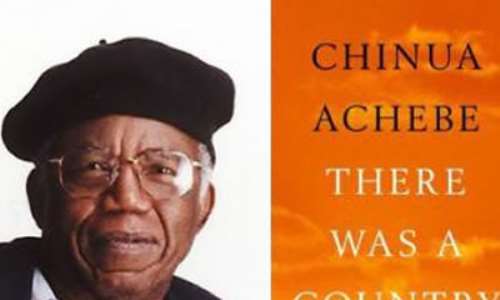
Image result for there was a country

 The Truth of Fiction by Achebe  is considered by Jeyifo to be the best essay by Achebe and it makes the speech of Jeyifo appear dumbed down in scholarly quality by contrast. The scholarly quality apart, Achebe was not really talking about Truth and Falsehood but about 'good and evil'. He spoke in a university that was renamed after a genocidist intellectual (three years after Achebe's lecture there) who, the year before Achebe gave his lecture,  publicly defended his wartime assertion that 'starvation is a legitimate weapon of war'. A journalist, Mr. Oparadike, had asked Awolowo during his 1983 Presidential campaign town hall press conference if he was prepared to address the concerns of those who felt aggrieved by the policy statement 13 years after the end of the war when the gruesomeness of the genocide was no longer in doubt? Awo said that he still stood by his statement and that he was indifferent to those who disagreed with him. Achebe was wondering how intelligent human beings could stoop to such a low level of morality in defense of evil and yet hardly any voice spoke up from the University of Ife in heroic defiance during and long after the genocide? 

That was what Achebe was addressing in his speech in which he also cited the epidemiological theory of a former minister for health in the Western Region who crossed over to AG from NCNC and went on to spear-head the foundation of the University of Ife. Dr. Sanya Onabamiro had written a book in which he had argued that the epidemics of childhood mortality was due to germs, parasites, and malnutrition and not due to witches. Opposed to him, Awo had published an essay in 1939 in which he claimed that Africans use juju as a science to kill one another by saying their names from a distance. This was apparently a rebuttal of Azikiwe who had called for the scientific method to be adopted by Africans in his 1937 Renascent Africa. Achebe sided with Zik in his lecture and dismissed claims by crazy preachers that the devil was to blame for man-made disasters such as genocide and childhood malnutrition. Jeyifo also indirectly sided with Azikiwe (without citing Zik and Awo) in his essays on 'How I survived Ebola' in which he rebuked STEM Professors for insisting on spiritual exorcism before they could occupy an official residence vacated by a colleague suspected of practicing occultism in the 21st century. A genocidist Nigerian army general, Obasanjo, also sided with Awo by calling on Africans to fight apartheid with juju.

It is strange that Jeyifo tried to equate the theoretical essay by Achebe with the claim of his friend, Professor Isola - alias the only honest man in the world - that his transfer from University of Lagos to University of Ife was motivated by the desire to join his friends in Ife and yet the friends were not yet at Ife by the time Isola went there. This mix-up of the dates in the mind of an old retired professor should not have been described as falsehood by Jeyifo. Perhaps Isola, the honest man, forgot the sequence of the events but he may have negotiated with the University of Ife that the condition for him to transfer was that they also try and lure his friends to Ife. Perhaps he was too modest to claim that he was the one who attracted his friends to Ife but such team-building is not unknown in academia. 

True or false, the memory of the Honest Man is not at the same level of the evil 'malignant fiction' that Achebe contrasted with the 'beneficent fiction' that tries to make the world better by imagining the sufferings of others instead of hanging on to the falsehood that men are better than women, that one race, class or caste is better than others, or that some speakers of a certain language are the source of all the troubles in the land, or that the Palmwine Drinkerd drank 150 kegs of palm wine every morning and 75 more kegs every evening to help him cope with the land of the ghosts. Some fictions like the square-root of minus one remain powerful in Mathematics despite being fictional, Achebe said. Perhaps he was suggesting that Nigerians should use the fiction of the Palmwine Drinkerd to try and curb alcoholism as a disease that kills many instead of celebrating it as a sign of macho manliness similar to the abuse of power by those who are power-drunk and who showed no compassion for the suffering of their fellow human beings while being applauded by what Soyinka metaphorized as the leftwing and the rightwing of the Cockroach.

Achebe concluded his lecture just as he started. Although he started by citing Picasso on the view that all art is false, he went on to state the fact that the painting of the civil war scene, Gurnica, by Picasso was banned by the fascist Franco dictatorship in Spain. Similarly, Achebe's novel, A Man of the People was published two days after the January 1966 coup and just because the novel ended with a coup, some people suspected that Achebe must have been among the coup plotters. Achebe turned the table on a university teacher who questioned him in 1974 by asking if he was in on the coup? Achebe asked the teacher if he had read the novel? He gave a vague answer. Achebe asked him if he also thought that the novelist planned all the corruption and violence that accompanied Opertation Wetie that took place in the novel, did the novelist also plan the counter-coup that was narrated in the novel? He said that it was excusable for soldiers (who could say that they did not have time to read novels) to go after him to seek to arrest him after the counter-coup but it was unacceptable for a professor to display the same ignorance about the truth of fiction.

Jeyifo, a Marxist theorist of the people and for the people, appears to have trivialized the enormity of the classic essay by Achebe by invoking the Afro-Cuban mythology of the mutual beheading of Truth and Falsehood in a fight and the adoption of the head of Falsehood by the body of Truth. The Cubans may just be referring to the historical materialist thesis that it is being that determines consciousness, and not consciousness that determines being. Such a statement does not come close to the eye-witness testimony against genocide by Achebe. It is sad that Jeyifo has consistently denied the genocide against the Igbo that Achebe was condemning by repeatedly and consistently describing it as 'alleged attempted genocide' in his serialized review of There Was A Country by Achebe. 

Hopefully, the call for restitution by Jeyifo in his opening paragraph would be extended to the 3.1 million mostly Igbo who were killed in Biafra without apology and without reparative justice. Let us hope that Jeyifo will spend his retirement advocating for the masses who were subjected to genocide in Biafra instead of equating their suffering with mythology. Even if mythology is a safe falsehood with which to indict genocidal regimes, the examples of Jeyifo's friends, Ola Rotimi (who published The Gods Are Not To Blame at the height of the genocide against the Igbo in 1968) and Soyinka who reflected on that genocide in 1975 (Death and the King's Horseman) should encourage Comrade BJ to abandon his long held genocide denialism and add his voice to those calling for justice. He has nothing to lose by examining what his comrade, Edwin Madunagu, has repeatedly denounced as the crass opportunism of the left during and after the Nigeria-Biafra war.