Showing posts with label Awolowo. Show all posts

Monday, January 31, 2022

My Cousin Was Lynched as an alleged Witch

 By Biko Agozino 

 During the time of goodwill towards all, bad news came during the Christmas holidays, on January 2 2022, saying that youths who returned for the holidays from distant cities, accused one of my cousins, Agatha Mgboebuba Nwaba, of being the witch who caused misfortune in their village. She was said to be the evil one who consumed the wealth of her husband who lived in London and who was said to have complained that it was his wife who used witchcraft to stop him from visiting home so that she would not be asked to account for the remittances he had been sending home to build a nonexistent house. He was reported to have told the lynch mob that he was not concerned and that they should do what they liked with her.


It was also alleged that she used witchcraft to kill one of their sons and that the same evil powers prevented her daughter's partner from going to pay the bride price for her daughter after she had four children with the Yoruba man. The daughter allegedly claimed that she found an exercise book in the house where her mother wrote a list of all the people she had killed and the dates that they died. That may be the kind of lists that every family keeps to remind them of those who brought them gifts during ceremonies and who deserve gifts in return when they have ceremonies of their own. The young people were obviously too biased against her and the list of names confirmed the bias. 

They were said to have paraded her around town with a tire hung around her neck to shame her but she showed no shame, perhaps because she was in shock. She was said to have begged one of her cousins who tried to intervene, not to let her in-laws beat her to death but her attackers threatened to attack her cousin too if he did not shut up. They were said to have tried to shame her extended family by asking them to take her back but they allegedly said that she was no longer in the shape she was as a young woman when they came to marry her and one of her uncles feared that she was the witch that killed his wife. Another cousin who believed the allegations like most people in Awgu (a local government headquarters) reported what happened in Awgu dialect as follows:

Mgboebuba lili amosu laegbuishi ndu ibe ayi. Ive ogbulu egbu kalikwalu. Shite la eka ada e nwayi ('Chikwado' la di e) o kelu igbuko ka eshilu chofuta ive o la eme. Ndu Awgu lo daide juwe ive oji egbushi ndu eka va du ucha, ya shi lo ndu ino e ive ya legbu. Eva ndu o kalaeke igbukwe kaligbukwelu. O gbuagakwalu madu, kalegbukwe tufu adaide. Eva mpam la mmam, okeke kele la nwae nwoke, onyebuchi adae nwayi la nwae dukota la ekwukwo ndu o gbugolu egbu. Oo ndu Awgu jikolu eka kpufute la orie Awgu, megbuo akaje, kpuluihia bia la uhumbele ezi nnae lo tigbuo ye, palu ozue ga gbavuo la ejo ovia du la nduegu ululor.

"Ovokwe ndu Uka gbulu e. Oo ndu ime obodo Awgu tigbuli e, maka la oshilu va la ya la ndu otu e la egbukota ote va ha tie ye ive, va lo tizie ye nke oji nwuhu. Onwevokwe onye kpolu ndu uwe ojii."

(Translation: "Mgboebuba ate witchcraft and was killing our people. The number she killed was a lot. Through the efforts of her daughter ('Chikwado' and her husband) whom she was preparing to kill too, that was how it was discovered what she was doing. Awgu people caught her and questioned why she was killing innocent people who have clean hands, she said that her enemies  were the ones that she killed. The names of the people she was preparing to kill were numerous. She had killed too many people and was going to kill more before she was caught. My father and mother, Okeke Kele and his son, Onyebuchi, his daughter and his grandchild were among the names found in the book of the people she had killed. The people of Awgu joined hands to drag her to Orie Awgu market place, mocked her, dragged her to her father's compound in Obugo village and beat her to death, then they carried her corpse and threw it away in the evil forest at the farm settlement of her husband's village, Ululor").

"It was not church people that killed her. It was the people of the inner village of Awgu who beat her to death, because she told them that she and her group will kill all those who beat her, then they beat her so much more that she was left dead. No one called the police."

They should have taken her to hospital to make sure that she was examined by experts if she admitted these things under torture and they should have reported the case to law-enforcement officers. The person narrating this to me emphasized that she was from my extended family. After parading her around the town all day, ‘the next day she was dead’, said the narrator.  Highly educated people strongly believe in witchcraft. But the surviving son of the woman is said to be demanding for his mother to be returned, I heard. There is an urgent need to run grassroots workshops to reeducate the people or else mutual distrust and suspicion will reign.

 They may have killed the poor woman, fearing her as a witch. Lethal witch hunting happened before in the same town a few years ago when some youth returned from the cities, burnt a native priest, Nwamme, to death and destroyed his shrine on allegations that he used his claimed powers to control thunder, Amadioha, to kill someone from the village who lived in a distant city. But our people carry on under thunderstorms with the belief that lightning only kills those whose hands are unclean. The frequent occurrence of misfortunes leads to suspicions that someone is behind everything. Fanon was right that Africans fear spirits more than they fear the police and the army of colonizers, at least they can bribe the police.

I spoke with the husband, Remi Nwankwo, in London by Whatsap and he told me that he suspects his uncle as the instigator because he had been threatening his wife. According to him, the uncle recently sent him a list of dead enemies allegedly compiled by his wife but it was typewritten and so no way to prove that his wife compiled such a list. The uncle then sent another list that was handwritten but it was not in his wife's handwriting. He asked the wife to leave the family home and go and stay in a hotel for a while but she told him that no one runs away from his father's compound. The uncle then phoned and threatened to send 'ndu ogba ozi' or messengers to force her out if she did not leave. He said that someone later sent him a video of how some people broke into his house and dragged his wife out and beat her to death. 

I asked him if he has reported the matter to the police and he said that I must know how the police work in Naija. I do not know what he means by that but I know that it is believed to be an abomination for a family member to invite the police in matters that involve other family members as suspects. He said that he had been ill since he returned from a visit home last year but that he is better now and is working to save for his airfare back home to see what he can do.

 Contrary to popular beliefs, Nnamdi Azikiwe (Zik) advised the new Africa of his Renascent Africa to move away from belief in witchcraft and develop the scientific methodology in everything they were doing. His aunt tried to scare him as a child by alleging that the reason why he once fell into a fire and why a dog once bit him was because his grandma was a witch trying to kill him. Zik stated in his autobiography, My Odyssey, that he did not believe the allegation because he said that his grandmother was a loving and caring kind women. According to him, the epidemics that kill lots of people are not caused by witches but by often preventable diseases. If witches kill people by poisoning the air, Zik reasoned, they too would breathe the same air and die for as the Igbo say, dibia la agwo otule, o dowelu ike ye la elu (the sorcerer who is concocting diarrhea, is he keeping his own buttocks in the sky)? Two years after Azikiwe published Renascent Africa in 1937, one of his future rivals, Obafemi Awolowo (Awo) published an academic journal article in 1939 arguing that Juju is an African scientific method that could kill enemies remotely by calling their names three times at crossroads. The colonizers must have been pissing their pants if Africans had such powers.

Awo believed that juju can be used by a detainee to vanish from prison even while chained to the walls. Zik was skeptical and asked for the proof of juju to be demonstrated through the scientific methodology by asking those who claim that they could change from one animal to another or fly on a broomstick to do so under systematic observation. Zik went on to test his own social scientific method of intellectual-activism by training journalists from scratch and appointing them to run his chain of newspapers to successfully campaign for the restoration of independence. 

Although his political party, National Council of Nigeria and Cameroons, allowed membership of Traditional Medicine Practitioners Association to join as a group member, the party did not use witchcraft beliefs to organize (unlike Awolowo’s Action Group that relied on the Ogboni Cult) at a time that people believed that Zik was what Phillip Emeagwali later reproduced from a newspaper report as ‘the Spirit-Man’ that supposedly made him bold enough to lead the fight against colonialism. Zik’s son, Chukwuma, said that his father had no magical powers. 

 Reports of witch hunting are on the rise across Africa at a time of social, security, economic and political crises facing Africans. If we do not end witch hunting in Africa, the disaster that faced medieval Europe may be looming in Africa. During the witch craze, Europeans murdered an estimated nine million people, mostly women, according to Stephen Pfohl. According to Mary Daly, alleged witches were killed by people who claimed to be Christians and they killed them while chanting: ‘In the name of the Father and of the Son’. 

 Today, the Europeans have come out of their dark ages, thanks to millions of Africans that they kidnapped and enslaved without pay for four hundred years. Nothing to do with religion or Obeah, wrote Eric Williams in Capitalism & Slavery (just republished); despite the fact that his high school teacher, CLR James, wrote in the Black Jacobins that the enslaved used Voodoo as the medium to organize their revolution against slavery in Haiti. 

Similarly, the National Church of Nigeria and Cameroons was used by the banned Zikist Movement to support the independence struggle by making Zik and others, living saints of Africa as opposed to European Churches and their saints and the war heroes invoked ancestral spirits of Chimurenga in Zimbabwe while also chanting the Rastafarian songs of resistance. Obasanjo wanted to use juju to fight against apartheid, and the Boers must have been shaking and quaking in their boots.

Max Weber theorized that it was the Protestant Ethic of hard work that first produced the Spirit of Capitalism in England and in the US compared to China, India or Africa; supposedly proving Marx wrong that religion is the opium of the people. WEB Du Bois (the only American Sociologist that Weber invited to contribute to his academic journal)  in Black Reconstruction in America proved Marx right and Martin Luther King Jr. agreed that it was the forced labor of millions for hundreds of years that produced capitalism, not protestantism which people of African descent embrace in their millions but still remain underdeveloped.

Now Europeans celebrate Halloween Day every year by giving sweets to children who knock on their doors at night while dressed as witches. They even allow people who identify as witches to practice their own faith that they call Wicca. At the same time, Africans are killing ‘witches.’ What if a poor child tries to do Trick or Treats during Halloween in Africa?

 When lightning strikes and kills someone from the village in a distant city, it is likely because people go about openly even during a thunder storm and not because of the priest in the village who claimed that he had the power to make rain and invoke thunder and deserved to be burned alive. It is not witchcraft that causes unemployment, poverty, and other misfortunes. When one branch of the extended family is doing relatively better while others are struggling, it is not because the head of that family used juju to tie the hands of the other branches of the extended family. Those who sacrificed to provide education or business startup for their children have seen more success among those children than those who failed to educate their children or train them in a trade and it has nothing to do with witchcraft. 

 African countries are at the bottom of the league tables of the Human Development Index reports of UNDP annually because Africans are denied educational opportunities by African rulers but not because of witches and wizards. Those who believe in spiritual warfare should say prayers but desist from attacking and killing fellow human beings with the bias that they are witches. Those who kill people for money ritual should desist from that and work smarter. 

 Difficult times promote witchcraft beliefs and desperate measures in all societies, according to a controversial academic conference on witchcraft at the University of Nigeria that was opposed by Christians. What distinguished the Igbo among their neighbors in the past was that while the Ibibio, for example, believed in appeasing or eliminating the suspected witch, according to my professor, Daniel Offiong who however failed to compare them with their Igbo neighbors who did not have significant beliefs in witchcraft; nor did he compare the Ibibio with their Tiv neighbors who believed that all their chiefs were witches, according to a brief review of Offiong’s book by G. I. Jones. 

 The current state of insecurity may be contributing to the rise of witchcraft allegations among the Igbo as some news reports indicate, though many more may go unreported, as I analyzed in an article for the African Journal of Criminology and Justice Studies. Let the youth be trained in scientific methods so that they can invent new technologies to improve life in Africa without blaming misfortunes on innocent people suspected of witchcraft to be lynched by misguided youths. Educate your children or sponsor them to learn a trade. No more witch hunting. 

 Africans must show more love for fellow Africans as the Igbo symbolized with Mbari sculptures where the living and even spirits cohabitate under one roof, according to Chinua Achebe. Stop trying to demonize fellow Africans to justify attacks against them. The fact that intoxicated drivers of vehicles that are not road-worthy but manage to ply on roads that are nor vehicle-worthy and cause many fatalities is not the fault of a poor woman in the village who should not be killed by people who claim to be Christians. If you see mobs attacking anyone as an alleged witch, oppose the attack and advocate for the person being targeted. You can also report it to the organization that is trying to end such violent crimes in Africa: Advocacy for Alleged Witches (AfAW). Google it.

UPDATE:


 Dr. Agozino is a Professor of Sociology and Africana Studies, Virginia Tech, Blacksburg, VA.

Wednesday, January 23, 2019

Otherness in African Cosmology

By Biko Agozino

African’s have always seen the world as multicultural and interdependent. The other is not to be killed or eliminated without harming the self. Chinua Achebe captures this notion with his Igbo saying that when one thing stands, something else stands beside it. One tree does not make a forest. The Igbo take this saying beyond the plant kingdom to say that the eagle should perch and the kite should perch, if one does not want the other to perch, it should show the other where to perch because there are many branches and many trees in the forest. The Igbo also say that there should be life for the fish and life for the river. They also say that all heads are equal and that the Igbo know no king, Igbo ama eze. 

This democratic principle was relatively contradicted by discrimination against women in the inheritance of property and by the divisions of some Igbo communities into Amala or the free-born and those who descended from Ohu (slaves) or from Osu (dedicated to the worship of shrines) beginning with the slave raids. However, the Igbo have used cosmopolitanism to combat such discriminations through equal educational opportunities. Nobody refuses to go to school, hospital, court, church, bank, or to take public transportation, or to watch football matches and Nollywood movies or to listen to music simply because any of the officials came from the prejudicial backgrounds that Azikiwe outlawed in the 1950s. Poor Ghanaians still dedicate their daughters as shrine wives to pay off debts. Soyinka credited Africans with exemplary religious tolerance because Africans never wage war to promote their religions. He also observed that the Igbo are admirable because they have never tried to invade and conquer their neighbors in order to build kingdoms or empires.

The earliest awareness of otherness in African worldview was the emergence of gender differences which demonstrated that men and women are the others of one another to be cherished and protected rather than to be combated and eliminated. Children came along as beloved others, other families emerged, other communities, other languages, other religions, other people’s property, rich people and poor people, insane people and sane people, our people and foreigners, good people and evil ones, the living and the ancestors.

Albinism became a marker for otherness probably with the arrival of Europeans in Africa. Albinos are sometimes referred to jokingly as White people. Perhaps because power and wealth were associated with the colonizers, some ritualists believed that using the body parts of an Albino to make money medicine will bring wealth and fortune to individuals. As a result, many Albinos are killed in different parts of Africa for ritual. Whiteness seduced many others into skin-bleaching and Fela Kuti criticized that with the song, 'Yellow Fever'. Ngugi portrayed this sickness in The Wizard of the Crow with the story of how the elites desired whiteness and how this drove them insane enough to imagine that there is a dollar tree where money grows to be plucked but female freedom fighters campaigned for a better society.

Arab settlers in North and East Africa also developed concepts of light-skinned supremacy in Africa but with emphasis on religion as the marker of insiders and otherness, believers and infidels. Colorism is still dominant here because Black Africans who are Muslims continue to be discriminated against by their fellow lighter skinned Muslims who claim Arabic descent as far south as Somalia.

The introduction of whiteness as a mark of privilege by Europeans also dominated Arabs and Asians in Africa who were treated as if they were dark-skinned compared to Europeans. In South Africa, this evolved into the system of apartheid which unjustly deprived the African majority of rights and presumed that they belonged to other homelands that were separate from the white dominated state. The African majority and their allies insisted that the country belongs to all who live in it.

The concept of Ubuntu or the bundle of humanity is used by Desmond Tutu to capture the African philosophy that I am because we are human as opposed to the Cartesian, I think, therefore I am. According to Tutu, everyone has something for which they should ask to be forgiven and everyone deserves to be forgiven something because there is nothing that is unforgivable. 

Achebe captures this principle of Ubuntu with the Igbo celebratory art form of Mbari through which the entire community comes together to build a miniature mud hut and populate it with the representatives of the community and with the foreigners in their midst as a tolerant prayer for protection from the ancestors and the gods also represented under one roof, following the principle that the sun shines on all without discrimination. 

Martin Luther King Jr. used the metaphor of the World House repeatedly to emphasize that people of African descent regard everyone as the children of one God to the extent that we say that injustice anywhere is a threat to justice everywhere and so white-supremacy is a threat to all. Rasta refer to such as One Love for all, not just for some.

Other forms of otherness were introduced into Africa by the colonizers in the form of homophobia whereas Africans did not give a damn about who people loved or how they showed the love until European colonizers outlawed homosexuality. The first military coup in Nigeria in 1966 announced that, in addition to fighting corruption, 'homosexuals will be shot'. Major Gideon Orkar echoed this in his April 1990 abortive regional coup announcement when he said that he was out to overthrow a '... corrupt ... homo-sexuality-centered ... administration...' Of the estimated 3.1 million people killed in the genocidal aftermath of the coup, none has been identified as a homosexual, showing that homophobia promotes violence that affects the whole society. Most people did not even know that homosexuality may have been a problem in the military perhaps because the British officers used it to humiliate the African recruits in order to dominate them. Long after the Europeans who imposed both the death penalty and the homophobic laws on Africa abolished both in Europe, the Africans are hysterically retaining such barbaric laws in Africa contrary to the tolerant culture of our ancestors.

No African society banned homosexuality before the colonization of Africa because Africans were more interested in the abilities of individuals to serve their communities and not the ways that consenting adults loved one another in the privacy of their homes. No African military ever had a Don’t Ask Don’t Tell rule for joining the military and no African society ever made a law called the Defense of Marriage Act. Africans always knew that some men liked to dress like women to perform the spirits of female ancestors in Agbomma or Gelede masquerades, for instance. 

Today, dressing like a woman in parts of Nigeria could get a man stoned to death under Islamic law while same-sex couples could be sentenced to 10 years in prison if convicted under the Nigerian criminal code. Critics point out that this is ridiculous given that the military have yet to defeat the Boko Haram militants who kidnap school girls in the busloads in a country that ranks first with the proportion of children out of school and with low human development index.

Similarly, Africans believed that there were people who had the powers of witchcraft but Africans did not go hunting for them to kill them until Europeans came with their interpretation of Christianity to emphasize exorcism or the killing of the other. In medieval Europe, an estimated 9 million people were killed, and most of the victims were women, on the suspicion that they were witches. No such genocidal records existed in Africa in precolonial times but today poor unemployed youth in South Africa and Tanzania often attack and kill poor old grannies on suspicion that they are the ones who use witchcraft to make jobs disappear or they blame it on those Africans who are attacked because their languages are said to sound incomprehensibly like Makwerekwere. In Nigeria, some parents are encouraged by fake pastors to drive six inch nails into the heads of their children because they were suspected to be witches who prevented their parents from becoming wealthy.

In Renascent Africa, Nnamdi Azikiwe (1937) called on Africans to abandon superstitious beliefs and adopt the scientific methods in healthcare and in the struggle for the restoration of independence. Two years later, Obafemi Awolowo published a rebuttal in a Liverpool-based magazine to say that Africans can use Juju as a science with which to kill their enemies from a remote distance by simply saying their names three times. The colonizers must have been shaking in their boots except that the African Juju only killed fellow Africans. For this reason, Fanon stated that the African was more afraid of the powers of ghosts than the powers of the corrupt police that could be bribed. Today, even professors of physics side with Awolowo against Azikiwe in the debate over the efficacy of the scientific method versus Juju. A Nigerian military dictator, Obasanjo, once called for Africans to use Juju to fight against apartheid.

One of the most dangerous otherness promoted by the divide and conquer strategies of Europeans is ethnicity which the Europeans wrongly called tribalism. According to Rodney, to call the genocide against the Igbo in Nigeria a tribal war would be to call Shell BP, the Labour Party Government in the UK, and even the Soviet Union, African tribes because they orchestrated the killing of the Igbo who led the struggle for the restoration of independence in Nigeria. Rodney added that there was no record of the Christianized neighbors of the Christianized Igbo committing genocide against them prior to colonialism. 

The solution is Nkrumah's United Republic of African States with the right to travel, work, and run for office anywhere while relying on federal might to stop oppressive otherness and to empower Africans with the scientific methods advocated by Azikiwe.

Sunday, December 16, 2018

Jeyifo's Truthful Lie

By Biko Agozino

Many congratulations to Comrade Biodun Jeyifo on his very well-deserved Honorary D.Lit award from Obafemi Awolowo University, Ife. I liked the way he dedicated the award to the Talakawa or the masses (to whom he often dedicates his newspaper columns) and I applaud his promise of restitution to the suffering masses of Nigeria in his opening paragraph of the award-acceptance lecture. He highlighted the various crises facing universities in the country from the higher administration to the faculty union and to the students' union governments that appeared delegitimized. This may be a taste of interventions to come from the recently retired Harvard University Professor.

I took the prompt from his acceptance lecture to go and read again the acceptance lecture for the first such D.Lit by the great Ife, awarded to Chinua Achebe. I wished that Ife had not politicized a similar award to Soyinka two years after Achebe's award, forcing him to withdraw his name from consideration (to which the ignorant administrators said, good riddance, according to Jeyifo) just before Soyinka won the Nobel Prize and they went begging him to accept but he gave them waka shege, the Nigerian equivalent of the middle finger salute that is shown with all five fingers spread apart and thrust in the face of the target. I would have loved to read Soyinka's acceptance speech too.

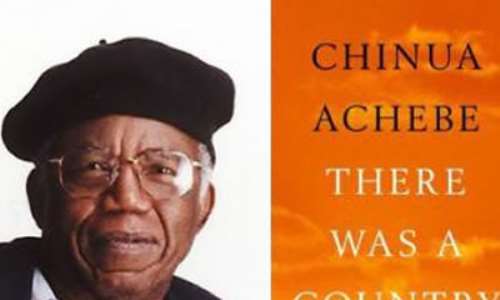
Image result for there was a country

 The Truth of Fiction by Achebe  is considered by Jeyifo to be the best essay by Achebe and it makes the speech of Jeyifo appear dumbed down in scholarly quality by contrast. The scholarly quality apart, Achebe was not really talking about Truth and Falsehood but about 'good and evil'. He spoke in a university that was renamed after a genocidist intellectual (three years after Achebe's lecture there) who, the year before Achebe gave his lecture,  publicly defended his wartime assertion that 'starvation is a legitimate weapon of war'. A journalist, Mr. Oparadike, had asked Awolowo during his 1983 Presidential campaign town hall press conference if he was prepared to address the concerns of those who felt aggrieved by the policy statement 13 years after the end of the war when the gruesomeness of the genocide was no longer in doubt? Awo said that he still stood by his statement and that he was indifferent to those who disagreed with him. Achebe was wondering how intelligent human beings could stoop to such a low level of morality in defense of evil and yet hardly any voice spoke up from the University of Ife in heroic defiance during and long after the genocide? 

That was what Achebe was addressing in his speech in which he also cited the epidemiological theory of a former minister for health in the Western Region who crossed over to AG from NCNC and went on to spear-head the foundation of the University of Ife. Dr. Sanya Onabamiro had written a book in which he had argued that the epidemics of childhood mortality was due to germs, parasites, and malnutrition and not due to witches. Opposed to him, Awo had published an essay in 1939 in which he claimed that Africans use juju as a science to kill one another by saying their names from a distance. This was apparently a rebuttal of Azikiwe who had called for the scientific method to be adopted by Africans in his 1937 Renascent Africa. Achebe sided with Zik in his lecture and dismissed claims by crazy preachers that the devil was to blame for man-made disasters such as genocide and childhood malnutrition. Jeyifo also indirectly sided with Azikiwe (without citing Zik and Awo) in his essays on 'How I survived Ebola' in which he rebuked STEM Professors for insisting on spiritual exorcism before they could occupy an official residence vacated by a colleague suspected of practicing occultism in the 21st century. A genocidist Nigerian army general, Obasanjo, also sided with Awo by calling on Africans to fight apartheid with juju.

It is strange that Jeyifo tried to equate the theoretical essay by Achebe with the claim of his friend, Professor Isola - alias the only honest man in the world - that his transfer from University of Lagos to University of Ife was motivated by the desire to join his friends in Ife and yet the friends were not yet at Ife by the time Isola went there. This mix-up of the dates in the mind of an old retired professor should not have been described as falsehood by Jeyifo. Perhaps Isola, the honest man, forgot the sequence of the events but he may have negotiated with the University of Ife that the condition for him to transfer was that they also try and lure his friends to Ife. Perhaps he was too modest to claim that he was the one who attracted his friends to Ife but such team-building is not unknown in academia. 

True or false, the memory of the Honest Man is not at the same level of the evil 'malignant fiction' that Achebe contrasted with the 'beneficent fiction' that tries to make the world better by imagining the sufferings of others instead of hanging on to the falsehood that men are better than women, that one race, class or caste is better than others, or that some speakers of a certain language are the source of all the troubles in the land, or that the Palmwine Drinkerd drank 150 kegs of palm wine every morning and 75 more kegs every evening to help him cope with the land of the ghosts. Some fictions like the square-root of minus one remain powerful in Mathematics despite being fictional, Achebe said. Perhaps he was suggesting that Nigerians should use the fiction of the Palmwine Drinkerd to try and curb alcoholism as a disease that kills many instead of celebrating it as a sign of macho manliness similar to the abuse of power by those who are power-drunk and who showed no compassion for the suffering of their fellow human beings while being applauded by what Soyinka metaphorized as the leftwing and the rightwing of the Cockroach.

Achebe concluded his lecture just as he started. Although he started by citing Picasso on the view that all art is false, he went on to state the fact that the painting of the civil war scene, Gurnica, by Picasso was banned by the fascist Franco dictatorship in Spain. Similarly, Achebe's novel, A Man of the People was published two days after the January 1966 coup and just because the novel ended with a coup, some people suspected that Achebe must have been among the coup plotters. Achebe turned the table on a university teacher who questioned him in 1974 by asking if he was in on the coup? Achebe asked the teacher if he had read the novel? He gave a vague answer. Achebe asked him if he also thought that the novelist planned all the corruption and violence that accompanied Opertation Wetie that took place in the novel, did the novelist also plan the counter-coup that was narrated in the novel? He said that it was excusable for soldiers (who could say that they did not have time to read novels) to go after him to seek to arrest him after the counter-coup but it was unacceptable for a professor to display the same ignorance about the truth of fiction.

Jeyifo, a Marxist theorist of the people and for the people, appears to have trivialized the enormity of the classic essay by Achebe by invoking the Afro-Cuban mythology of the mutual beheading of Truth and Falsehood in a fight and the adoption of the head of Falsehood by the body of Truth. The Cubans may just be referring to the historical materialist thesis that it is being that determines consciousness, and not consciousness that determines being. Such a statement does not come close to the eye-witness testimony against genocide by Achebe. It is sad that Jeyifo has consistently denied the genocide against the Igbo that Achebe was condemning by repeatedly and consistently describing it as 'alleged attempted genocide' in his serialized review of There Was A Country by Achebe. 

Hopefully, the call for restitution by Jeyifo in his opening paragraph would be extended to the 3.1 million mostly Igbo who were killed in Biafra without apology and without reparative justice. Let us hope that Jeyifo will spend his retirement advocating for the masses who were subjected to genocide in Biafra instead of equating their suffering with mythology. Even if mythology is a safe falsehood with which to indict genocidal regimes, the examples of Jeyifo's friends, Ola Rotimi (who published The Gods Are Not To Blame at the height of the genocide against the Igbo in 1968) and Soyinka who reflected on that genocide in 1975 (Death and the King's Horseman) should encourage Comrade BJ to abandon his long held genocide denialism and add his voice to those calling for justice. He has nothing to lose by examining what his comrade, Edwin Madunagu, has repeatedly denounced as the crass opportunism of the left during and after the Nigeria-Biafra war.

Tuesday, August 8, 2017

Fake Anti-Igbo Song


I doubt the authenticity of the song circulating online that calls for genocide against the Igbo in Nigeria. To say that I doubt the authenticity does not mean that it should not be taken seriously, otherwise why bother commenting? Even fake news and fake songs can have devastating consequences if gullible people swallow the propaganda and act it out. Correct me if I am wrong but I think that Africans should not believe everything they hear on the internet. We should engage in more critical thinking.

I doubt if Hausa/Fulani warlords would authorize a genocidal war song and rely on women to sing it for the men to act upon. The Hausa/Fulani are very patriarchal in their culture and although they have had warrior queens like Queen Amina of Zaria and the Boko Haram used women as suicide bombers, it is very unlikely that they would use the voices of women to declare war. Women may ululate to celebrate victory by their men but it is unauthentic for women to be the ones calling for the rape and genocide of Igbo women, children and men by Hausa/Fulani men.

I doubt the authenticity of the song also because the accent is not a native Hausa speaker accent. Although I do not speak Hausa (Ba na ji Awusa), the pronunciation of the genocidist term Nyamiri in the song as Nyamuri is an indication that the singers were not native speakers but agents provocateur trying to egg the Hausa/Fulani youth into a genocidal frenzy against the Igbo who have never done them any wrong, contrary to genocidist propaganda that the Igbo killed northern leaders in the past when the Igbo did no such thing.

Western Nigerian officers (including some Western Igbo) led the first bloody coup in the country to free their leader, Awolowo, from prison and impose him as the Prime Minister. They later blamed it on Eastern officers who actually foiled the coup. Then Western Nigerian and Middle Belt Christian officers led the genocidal war against the Christian Easterners and blamed it on the Muslim Northerners to ignite an endless religious war but the Igbo have managed to avoid buying this trap. Yet the hatred of the Igbo remains the major thing that unites all other Nigerians, according to Achebe.

The authenticity of the anti-Igbo song is also raised by the fact that the song made an exception for the Yoruba, calling for them to be spared in the genocide against the Igbo. Yet it will not be easy to tell who is Igbo and who is Yoruba in the absence of tribal marks that are no longer common among the Yoruba. When the rain falls, it will not fall on one man’s house top.

I doubt the authenticity of the song furthermore because the beat is not the traditional Hausa beat with traditional instruments. Rather it is a computerized disco beat that is actually danceable and I doubt that genocidists would prefer to use disco beats to issue genocidist calls even if their target audience is the Hip-Hop loving generation of today. Dem go de Pose, is what Baba Fryo called such a pretense.

I call on all Africans to disavow songs of hatred and proclaim the fact that the Igbo are not ‘a curse to Nigeria’ but a blessing to Africa. All Nigerians should reject genocidist propaganda and add their voices to the defense of those who are targeted by haters, no matter their ethnic groups. Choose roses than rape, choose Ubuntu than Ubulani, urges the people’s poet, Mzwakhe Mbuli.


Dr. Biko Agozino is a Professor of Sociology and Africana Studies, Virginia Tech, Blacksburg, VA 24061.

Wednesday, April 27, 2016

Details of My New Book on Arthur Nwankwo

-->

ISBN: 978-2904-53-8 (Paper); 978-2904-54-6 (Hard Cover) First Edition (C) Agozino 2016

Blurb:
This book situates the socio-political thought of Agwuncha Arthur Nwankwo within the paradigm of Africana Studies as a way of encouraging more scholars in the field to pay more attention to contributions from scholars based in Africa. At the same time, scholars in African Studies should radicalize the field by embracing the revolutionary field of Africana Studies to make all the respected African Studies Institute in the world to evolve into Africana Studies Institutes. Nwankwo’s revolutionary theory and praxis are challenging to academic scholars in Africa who appear to be satisfied with quoting theorists from Europe without adequate originality in the development of indigenous knowledge systems for the explanation and transformation of the enduring conditions in Africa. This book differs from the previous tributes to Nwankwo by his admirers in the sense that this is not a tribute but a constructive critique and also because this book goes beyond the theoretical and historical texts of Nwankwo to read his creative writings inter-textually.

Praise for the book:
“… critically incisive study of outstanding intellectuel engagé Agwuncha Arthur Nwankwo by Biko Agozino, one of the most prolific and accomplished scholars of his generation.”  - Herbert Ekwe-Ekwe, Visiting Professor in Graduate Programme of Constitutional Law, Universidade de Fortaleza, Brazil.

"The book is very informative, lucid and analytical. It provides a rigorous analysis of one of Nigeria's and Africa's foremost activist and revolutionary (Arthur Nwankwo) who challenged the oppressive and unjust rule of military and civilian regimes in Nigeria. Furthermore, the book elucidates the complexity of the Nigerian state and the position of the Igbo Nation. The book is compulsory reading for all those interested in both the Nigerian and African project." Professor Akpan Hogan Ekpo, Director General, West African Institute For Financial And Economic Management (WAIFEM), Central Bank of Nigeria Learning Centre and Professor of Economics, Department of Economics, University of Uyo, Akwa Ibom State.

‘This is the first systematic study of the ideas and praxis of Arthur Nwankwo. Biko took a studied and methodical approach to Nwankwo's worldview and political practice in a critical and yet fair minded way. It is an inspiring work in the realm of African political thought which scholars and activists will find useful.’ Professor Abubakar Momoh, Director of the National Electoral Institute, Abuja, and Professor of Political Science, Lagos State University, Lagos.

‘The book Critical, Creative and Centered Scholar-Activism: The Fourth Dimensionalism of Agwuncha Arthur Nwankwo by Professor Agozino presents a brilliant, refreshingly in-depth understanding of the works of the great African intellectual, Arthur Nwankwo. The book provides uncommon insight into the possible motivations and reasoning behind certain beliefs of Dr. Arthur Nwankwo as espoused through some of his published works. Reading through Professor Agozino's work should remind the present and future generation of Africans, that life, to be well lived must be founded on values, principles and moral convictions. Writing the book must clearly have been a sacrificial exercise embarked upon for the sole purpose of bringing what should come to light, to light. Generations to come owe a mountain of debt to professor Agozino for this selfless act.’ Dr. Chika Ezeanya, Assistant Professor of African Business Studies, University of Rwanda, Kigali.

‘It seems safe to say that  CRITICAL, CREATIVE AND CENTRED SCHOLAR ACTIVISM: THE FOURTH DIMENSIONALISM OF AGWUNCHA ARTHUR NWANKWO will be one of the best social science books of the year in Nigeria and may be of the decade. Biko, arguably one of the worlds leading experts on sociology and Africana Studies, made a powerful case for Afrocentricity: "AFROCENTRICITY … DOES NOT START FROM THE PREMISE THAT EUROCENTRICISM IS ALWAYS WRONG BUT FROM THE FACT THAT WHATEVER IS THE FOCUS OF ANY SCHOLARSHIP SHOULD BE PLACED AT THE CENTRE OF SUCH SCHOLARSHIP". By this, Afrocentricity as an approach, is elevated to a global principle with broader human implications.’ Dr. Augustine Obelagu Agu, Retired Senior Social Policy Officer, UNICEF, Independent Policy Consultant, Texas, USA.

‘I enjoyed reading every single line of your work; and I’m quite surprised that you had to produce this solid work in 2 months. That’s an incredible turn out time for an incisive scholarly work of this nature. It’s a big lesson for me who has been playing around endlessly with two manuscripts for years. … Your big brain is, therefore, also partly responsible for the global warming.’ Dr. Ifeanyi Ezeonu, Professor of Sociology, Brock University, Canada. 

About the Author:
Biko Agozino is a Professor of Sociology and Africana Studies, Virginia Tech, Blacksburg, VA. He is the author of the following books - Today Na Today (Poetry), 2013; The Debt Penalty (Play), 2010; ADAM: Africana Drug-Free Alternative Medicine, 2006; Counter-Colonial Criminology, 2003; Pan African Issues in Crime and Justice (co-edited), 2004; Nigeria: Democratising a Militarised Civil Society, (co-authored) 2001; Theoretical and Methodological Issues in Migration Research (edited), 2000; and Black Women and the Criminal Justice System, 1997. Also Director-Producer-Editor of Reparative Justice, 30 minutes, color, African Independent Television, Lagos, Nigeria, 2002; Director-Producer of CLR James: The Black Jacobins Sociology Series, 2008; Director-Producer, 'Shouters and the Control Freak Empire', Winner of the Best International Short Documentary, Columbia Gorge Film Festival, USA, 2011. Editor-In-Chief of the African Journal of Criminology and Justice Studies, and Series Editor, Ashgate Publishers Interdisciplinary Research Series in Ethnic, Gender and Class Relations. Ph.D. (Edinburgh); MPhil. (Cambridge); B.Sc. First Class Hons (Calabar).

Book Review Editors of Journals who wish to receive review copies and those who wish to order copies and or arrange readings should contact the publishers or the author directly:

Publishers Contact: Fourth Dimension Publishing Co. Ltd, House 8, First Avenue, City Layout, New Haven, Enugu, Enugu State, Nigeria. Phone: +2348035511487; +2348055790009; email: chairman@arthurnwankwo.com or Arthur.nwankwo@yahoo.com www.arthurnwankwo.com
 
Author Contact: Dr. Biko Agozino, Professor of Sociology and Africana Studies, Virginia Tech, 225 Stanger Street, 562 McBryde Hall, Blacksburg, VA 24073; Phone: 1-540-231-7699 (Office); Fax: 1-540-231-3860. Email: bagozino@gmail.com or agozino@vt.edu blogsite: www.massliteracy.blogspot.com

Monday, October 8, 2012

Awolowo Was No ‘Friend’ of Ours


By Biko Agozino

I eagerly await the arrival of my copy of Achebe’s personal historiography of Biafra with my mouth salivating in anticipation, given the spoilers already raising storms of debates. The charged debate over Achebe’s book gives Nigeria enough reason to reverse the dumb policy of Obasanjo who banned the teaching of history in Nigerian schools under the excuse that history is a yeye subject that does not lead to employment. Dalu (thank you), Nna anyi (our father) Achebe, you will live life until the endless time! I will wait until I have read every word and reflected on it before I comment on your magnum opus.

Meanwhile ... In response to this welcome addition to the cleansing of the historical conscience of Nigeria by Chinua Achebe, some misguided and misinformed miscreants have dredged up what looks like a fabrication, claiming that Awolowo regarded himself as a friend of the Igbo. The strange document lacks any of the clarity of the sage and digresses from a serious discussion of the haunting responsibility for genocide to the trivial mythology of fish as an astrological sign. That apparent forgery smell foul like a dead fish all right for the following reasons supported by quotations on friendship from Awolowo’s favorite text, the Bible:

1)   Awolowo was an elder, uncle or father of the Yoruba nation and not a friend of the Igbo. But being a beloved elder does not mean that you could never err: Soyinka has a character in Mad Men and Specialists who despite his immense wisdom grossly erred by teaching military officers how to enjoy cannibalism. ‘As soon as he began to reign and was seated on the throne, he killed off Baasha’s whole family. He did not spare a single male, whether relative or friend.’ 1 Kings 16:10-12

2)   To suggest that Awolowo saw himself as a friend is to distance himself from the Igbo as if we are not related, ‘why can’t we be friends’ is a polite turn-down for a jilted lover, as Louis Armstrong and Ella Fitzgerald dueted. ‘Then he said to them, “This is what the LORD, the God of Israel, says: ‘Each man strap a sword to his side. Go back and forth through the camp from one end to the other, each killing his brother and friend and neighbor.’” Exodus 32:26-28

3)   If Chief Jeremiah Obafemi Awolowo really said what was attributed to him as a justification for the absolutely unjustifiably act of genocide, he must have been reading the book of his angry name-sake too literally: ‘For this is what the LORD says: ‘I will make you a terror to yourself and to all your friends; with your own eyes you will see them fall by the sword of their enemies. I will give all Judah into the hands of the king of Babylon, who will carry them away to Babylon or put them to the sword.’ Jeremiah 20:3-5
4)   To claim that you are a friend of someone is no argument for mitigation in any court of law especially when the charge is genocide: ‘You will be betrayed even by parents, brothers and sisters, relatives and friends, and they will put some of you to death.’ Luke 21:15-17

5)   I have never met any young Nigerian who calls Azikiwe, Balewa, or Awolowo, nor the legends, Kano, Achebe and Soyinka his friend; they were/are more like elders. An old man who goes about saying that he is a friend of starving children but refuses to feed them as punishment for their parents is surely dodgy and dishonest. I doubt if Awolowo stooped that low.

6)   As a statesman, you are not expected to serve only your friends – you serve the whole country whether you love them or hate them. "My life has been a joy to me wherever I may be, for I have learnt to live in peace with either friends or foes." NNAMDI AZIKIWE.

7)   To say that Awolowo is a friend of the Igbo suggests that the Igbo regarded Awolowo as their enemy despite the fact that predominantly Igbo officers led a military coup for the explicit purpose of freeing Awolowo from prison and making him an executive president. As one of the coup plotters, Nwobosi, stated, he supported Awolowo over his next-door neighbor, Azikiwe: ‘Awolowo was our man, our man for the job; I don't think he was even the best friend of the Igbo. He wasn't, but we wanted a job done and we knew that the man who would do it well was Awolowo.’  Odia Ofeimum, the secretary of Awolowo, was quoted as saying that this is true but strange to Nigerians today because they do not know any patriotic Nigerians who would rise above ethnicity. No wonder Odia is yet to publish that book of his.

8)   Gowon was reported as having apologized to Asaba people for the massacre that took place in the town under his watch as Head of State but he claimed that he was ignorant that such atrocities happened. He is yet to apologize to the Igbo for the genocide that he was fully aware of and over which he actively presided. Descendants of Awolowo, Enahoro, Gowon, Danjuma and others still alive should lead in the soul-searching that Achebe has launched and support the call for reparations that Wole Soyinka has been making, lest future generations continue to believe that the genocide of more than 3 million of our compatriots was a heroic thing to be celebrated with honors and rewards.

9)   Starvation as a weapon of war especially after seeing that the prime victims were children is not just a mistake by Awolowo, it is a wicked crime against humanity. Even after the war, did he justify the stripping of Igbo families of all their life savings in exchange for 20 pounds to demonstrate his ‘friendship’? ‘Jesus answered, “Can you make the friends of the bridegroom fast while he is with them? Luke 5:33-35

10)  It is painful to associate the respected sage with such a crime but he allegedly bragged that he saw malnourished children with his own eyes but said that he did continue to starve them because the adults were not also equally bloated with kwashioko and dying to surrender. Did he really say that?

11) He said that the allocation of public funds to a state in Nigeria was a sign of his friendship and expected to be commended for claiming that he did not demand 10% for himself out of the statutory allocation. Now that does not sound like the wise Awolowo. ‘If anyone denounces their friends for reward, the eyes of their children will fail.’ Job 17:4-6

12)  He said that he built schools in Warri but the credit probably belonged to the communities that built their own schools through community effort and he claimed that he saved abandoned properties for the Igbo in Lagos, yet Ojukwu had to go to court in 1985 before recovering his father’s property. If he suggested that Ojukwu was the real enemy of the Igbo, it must have been in the context of the 1983 election when Ojukwu declared for the National Party of Nigeria rather than join the Progressive Parties Alliance of Awolowo’s Unity Party of Nigeria, Azikiwe’s Nigerian People’s Party, and Aminu Kano’s People’s Redemption Party.

13) ‘You are not my friend, my friend.’ That is a style of rhetoric that Nigerians use as a retort whenever an antagonist calls you his friend without meaning it. We are expected to know who our friends are even if we may not know our brothers and sisters from other mothers or fathers. Achebe’s book should be read by all Nigerians and by all Africans to learn how to love one another like brothers and sisters and avoid any excuses to indulge in genocidal rages that have continued to consume the continent since the Igbo genocide as Herbert Ekwe-Ekwe has been documenting. Instead of reacting by defending ethnic icons, let us all demand that the Nigerian government, the British government, Russia and Egypt should atone for this heinous crime that has robbed Nigeria of some of its greatest minds. Reparations for the Igbo genocide will help to heal the open sores of that crime and pave the way for a progressive future for all Africans to enjoy.