
On A Soyinka Prize In ‘Illiteracy’, By Biko Agozino
by Premium Times July 14, 2018 Reading Time: 11 mins read
0
I will admit to a ‘strategic misreading’ that is necessitated by placing the text within the context of a recent history of trauma that the author did not simply witness as a bystander but one in which he actively tried to stop the genocide and earned himself solitary confinement without trial.
On July 13, 2018, the 84th birthday of Olumo Wole Soyinka, the 1986 Nobel Laureate for Literature, I honoured him by revisiting a debate that is raging on the internet over what many call my misreading of his work, especially with reference to my interpretation of his play, Death and King’s Horseman. Literary experts have been marveling about the ‘Author’s Note’ that accompanies Death and the King’s Horseman. Most playwrights leave it to the directors and producers of their play to interpret it as they wish but Soyinka was worried that most experts would misread the play. He took the unusual authoritarian step of stipulating how the play should be interpreted but the critics appear not to notice and have continued to misread the play, in my own humble opinion. Soyinka leaves clues that would guide readers to decode his original intention in writing the play but most literary critics miss the point and some accuse me of being the mis-reader.
The very first sentence in the Author’s Note may have led many critics astray by stating that the play is based on real historical “events which took place in Oyo”, which the author defines as “an ancient Yoruba city of Nigeria”. This is misleading in a number of ways that literary critics should have been able to understand. To say that the events took place in 1946 would be to localise the time and space of the dramatic events, whereas in the world of theatre, events do not take place exclusively in the setting but also on every stage where the play is produced. Soyinka expected that literary theorists would understand that the playscript is not simply an archival document or ethnographic report but the work of original creation, even when based on real events. The play was not expected to be read as the verbatim report of a tragic case that took place once upon a time. This is true of all works of creative writing that are supposed to be inventive, no matter how much resemblance there may be between fiction and reality. In fact, many writers include a disclaimer that any resemblances to real events are unintentional. As a matter of fact, the same can be said about reality genres that are full of inventions too. Soyinka clearly states in the first paragraph of his Author’s Note that he made “changes” in the narrative “in matters of detail, sequence and of course characterisation.”
He also informs the illiterate critics that he deliberately set the play back a few years “while the war was still on, for minor reasons of dramaturgy.” Here, Soyinka is guiding the would-be producer away from a simplistic historical interpretation of the play as being only relevant to the case of 1946, given that dramaturgy grants artistic license that defies the laws of historical specificity. In addition, Soyinka may have misled the interpreters of the play by saying that Oyo was an “ancient Yoruba city of Nigeria.” Here he could be challenged by historians who may point out that Oyo was an ancient Yoruba Empire and not simply a city and that by 1946, it was no longer simply a Yoruba city but a multicultural one. Moreover, nothing ‘of Nigeria’ can be said to be ancient because Nigeria itself is a modernist invention by colonisers. The hint about the Nigerian setting of the play should have encouraged the critics to understand that the play is not only about a Yoruba tragedy but about a Nigerian tragedy. The reference to “while the war was still on” should have massaged the memory of the critics to remind them that the play was published only five years after a tragic genocidal war in Nigeria in which Yoruba elites played a leading aggressive role, along with other ethnic elites in Nigeria. This play, in my lay opinion, is better understood as part of the soul-searching by Soyinka after he was released from solitary confinement for opposing the genocidal war against the Igbo. Why were highly educated Yoruba leaders the ones who cheered on the genocide against the Igbo in Biafra?
Also, Soyinka indicates that those who were interested only in the factual account of the case of 1946 should go and read it in the British National Archives in Kew. He also points out that those who want to read a more exact historical reenactment of the case should consult the “fine play in Yoruba (Oba Waja) by Duro Ladipo.” In other words, Death and the King’s Horseman is not that kind of historical re-enactment nor is it the kind of ‘misbegotten’ German television film about the case. The play was a more urgent intervention while Soyinka was in exile following the end of the war and his release from solitary confinement for having the audacity to oppose tyranny. Unlike his other plays, he did not wait for the play to be produced before he published it. I believe that Soyinka was directly and indirectly challenging his fellow Nigerian intellectuals to account for their opportunism in supporting a genocidal war that took 3.1 million lives in 30 months.
I offer the original interpretation that Soyinka was referring to the genocide against the Igbo, which was the theme of the novel that he referred to, “Season of Anomy”, in which he recounted the eye-witness account of how fellow Nigerians hunted down tens of thousands of innocent Igbo men, women and children and massacred them in a pogrom that led to the secession of the Eastern region and the intensification of the genocide.
In the third paragraph of the author’s note, Soyinka declares that the “bane of themes of this genre” is that once the text appears, ‘they acquire the facile tag of “clash of cultures”’. He rejected such a label as “prejudicial” in the sense that it is prone to “frequent misapplication” and also because the label “presupposes a potential equality in every given situation between the cultures of the coloniser and the colonised ‘on the actual soil of the latter’”. Soyinka went on to award “the overseas prize in illiteracy and mental conditioning” to the writer of the blurb of the American edition of his novel, Season of Anomy, for ‘unblushingly’ stating that the novel is about the “clash between old values and new ways, between western methods and African traditions”. Soyinka explains that it is due to “this kind of perverse mentality” that he was forced to warn future producers (and critics) of the play to avoid “a sadly familiar reductionist tendency” and instead attempt to capture “the far more difficult and risky task of eliciting the play’s threnodic essence.” Experts on the work of Soyinka are baffled by this injunction and wonder openly what he was banging on about? What is Soyinka trying to hide, asked Anthony Kwame Appiah? He was trying to reveal something, in my own opinion.
To repeat, I offer the original interpretation that Soyinka was referring to the genocide against the Igbo, which was the theme of the novel that he referred to, Season of Anomy, in which he recounted the eye-witness account of how fellow Nigerians hunted down tens of thousands of innocent Igbo men, women and children and massacred them in a pogrom that led to the secession of the Eastern region and the intensification of the genocide. In that novel, he mocked the archeologists for poking around in search of fossilised bones while fresh blood flowed like river Niger in the country and they did not seem to be bothered. He also challenged the sociologists who came with ‘erudite irrelevances’ about marriage and divorce but refused to join him in opposing a genocidal war. The novel depicts the Marxists who were locked up in a mental asylum as a phrase-monger who failed to recognise the revolutionary situation in the country and instead rallied in support of the genocidal military dictatorship, rather than turn the civil war into a liberation war. To suggest that the novel was about the clash of cultures was a strategy to condition the mentality of Nigerian intellectuals towards the acceptance of the propaganda that the Igbo who led the struggle for decolonisation were primitive tribalists, perhaps because they had no chiefs, while the ethnic groups that ganged up against them were more civilized because they were monarchical, according to the ideologues of colonial domination, such as the Oxford colonial anthropologist, Margery Perham, who advised the military dictators to impose chiefs on the radically democratic Igbo in order to control them better. Walter Rodney also observed that to call the genocide against the Igbo a tribal war would be to call Shell BP an African tribe (along with the Labour Party government of the UK and the Soviet Union that generously supplied the weapons of mass destruction). Ikenna Nzimiro argued that the Marxists in Biafra were engaged in class struggles while the Marxist in Nigeria were engaged in national defencism.
The ‘threnodic essence’ of the play refers to funeral songs in Greek tragedies and I believe that Soyinka was inviting the producers of the play to imagine a national mourning for the 3.1 million killed in Biafra that the country has refused to mourn. Agwuncha Arthur Nwankwo had been calling for a National Day of Igbo Mourning to be recognised by the Nigerian government as part of the atonement.
In the final paragraph of the Author’s Note, Soyinka observes that an alternative structuralist interpretation of the play is to see it as a cruel joke on the British colonial District Officer. He quickly dismisses such a reading as distasteful and adds that he deliberately avoided writing dialogue or scenes that would support such a misinterpretation. He dictates that “No attempt should be made in production to suggest it’. This sounds like an angry response to critics who choose to misread his works for ideological reasons while ignoring the concrete conditions that his works address.
A prominent Marxist literary theorist that I admire, Biodun Jeyifo, who is an expert on the work of Soyinka, was invited by the BBC to write about any work of literature that he saw as being representative of global culture. He chose to write beautifully about Death and the King’s Horseman as an anti-colonial play that tries to subvert the use of the Queen’s English by creating a ‘future’ tradition of the Anglophone that is more figurative than the English language. He invoked the work of Marxist Cultural Studies by Raymond Williams (but without mentioning the more relevant anti-colonial, anti-racist, and anti-sexist work by Stuart Hall) to suggest that the other Englishes around the world serve to subvert the domination of the world by standard English.
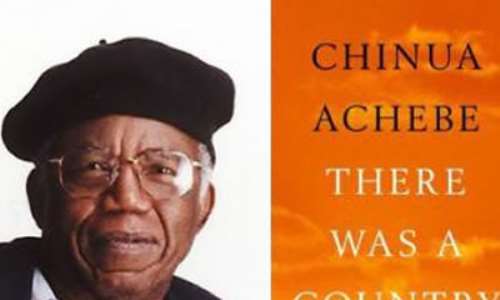
I pointed out that Jeyifo's interpretation is too superficial for a Marxist because the ‘thredonic essence’ of the play is not to show that Africans can speak English better than the English. I suggested that a Cultural Studies reading of the play would not have focused exclusively on the beautiful writing or language of the play but would have tried to see the challenge to monarchism and oppressive traditions in the play. Jeyifo told me privately that I should go and read the play again because it is not against the monarchy or against ritual suicide but simply against the colonial domination of African cultures. Moreover, the melodrama about the coveting of the virgin bride of another man as a right in Esin Oba's rites of passage to ritual suicide appears to be the ridiculing by Soyinka of the rapaciousness of the genoicidist troops that forcibly took underage girls and the wives of other men and claimed them as 'wives', as Achebe recounted in There Was A Country, and as Boko Haram continues to do. I admitted that I could be accused of misreading the play but I called it a strategic misreading and wondered if it is possible for an expert on the work of Soyinka to misread it? Soyinka seems to think so and that is the whole point of his detailed telling off of the experts in his Author’s Note.
I am only saying that there is something missing in the community of Soyinka interpretations and I contend that what is neglected by critics is not minor but a central aspect of his work – his self-sacrificial opposition to the Igbo genocide in particular as a foundational part of his oppositional aesthetics in the face of tyranny.
Contrary to the claim that Death and the King’s Horseman is only an anti-colonial play, Soyinka concludes his Author’s Note by stating that “The Colonial Factor is an incident, a catalytic incident merely.” To him, the central ‘confrontation’ or conflict that he tried to resolve in the play was ‘metaphysical’ in the sense that it played out in the world of “the Yoruba mind – the world of the living, the dead and the unborn, and the numinous passages which links all: transition.” Soyinka was puzzling about the metaphysics of the Yoruba worldview that made it possible for the best educated characters in the play to be the ones who cheered most vociferously for Elesin to abide by the tradition that expected him to kill himself in honour of a dead king. Similarly, Soyinka was wondering why the best educated Yoruba were the cheer-leaders of the genocide against the Igbo.
Soyinka advised producers to try and capture this tragedy by using music to represent the macabre dance to the “music from the abyss” by the intellectuals who danced while millions were being slaughtered in Biafra. In his Talakawa column, Jeyifo once wrote that while blood was flowing in Biafra, (1967-1970) he led his secret Pyrates fraternity, that Soyinka founded as a student at the University of Ibadan, in chanting, 'Give us this day, give us this day, our daily manya' (wine in Igbo). Were the elites drunk on power during the genocide? The play symbolizes this with the 'Not I bird' and the hunter who consumed many gallons of manya before trying to kill the innocent Not I bird.
I am not an expert in dramaturgy but I love the work of Soyinka. I cited his essay on Neo-Tarzanism in my criticism of the film, Black Panther, which I called an example of neo-Tarzanism. Following the serialisation of the criticism, I was invited by Assumpta Oturu to the KPFK public radio in Los Angeles to discuss the film with an Ethiopian publisher and an African American director of the Pan African Film Festival. During the discussion, the Ethiopian said that we should not condemn the presence of monarchies in Africa because there were popular emperors such as Mansa Musa and Haile Selessie who were admired by Africans and by the African diaspora. The director of the Pan African Film Festival questioned my reference to Soyinka because he saw Death and the King’s Horseman as an indication that Soyinka was a monarchist who supported even the tradition that the horseman should commit suicide to honour the dead king.
As Killmonger asked derisively in the film, I asked, “This is your king?” Why must African brothers be expected to fight to the death to determine who should be the next king when we can just hold elections to select our leaders with term limits? I stated that Soyinka used that play and almost every play of his to undermine the institution of the monarchy and call for democracy, which he is on record as admiring in Igbo culture. He tried to spare the life of the horseman in the play and his other tragedies – Kongi’s Harvest, Madmen and Specialists, King Babu; his novels, his poetry and his memoirs all support my interpretation of his anti-monarchical orientation. Since the experts who have studied his work have focused almost exclusively on the structuralism, I propose to offer a post-structuralist or deconstruction radicalisation of his body of work to show that the tragedy of state violence, especially against the Igbo, is at the centre of the conflicts that he has been trying to resolve. Just as the genocidal war was waged without a cease fire for humanitarian interventions, the author coincidentally instructs on page 8 of Death and the King’s Horseman that ‘The play should run without an interval.’
I agree with critics who will charge that I am misreading Soyinka here. If so, I will admit to a strategic misreading that is necessitated by placing the text within the context of a recent history of trauma that the author did not simply witness as a bystander but one in which he actively tried to stop the genocide and earned himself solitary confinement without trial. Sociologists approach the work of writers by taking into consideration, the context of the private and the public lives of the authors, whereas literary theorists may concentrate exclusively on the technical, language, or structural aspects of the script as instructed by T.S. Eliot in his foundational essay, “Tradition and the Individual Talent”.
To reiterate, what I am offering is a sociology of literary interpretation of Soyinka and I am certain that the rebel in him may force him to disagree with my interpretation and award me a national illiteracy prize. I am not contending that all existing interpretations of Soyinka are wrong. I am only saying that there is something missing in the community of Soyinka interpretations and I contend that what is neglected by critics is not minor but a central aspect of his work – his self-sacrificial opposition to the Igbo genocide in particular as a foundational part of his oppositional aesthetics in the face of tyranny.
Biko Agozino is a professor in the College of Liberal Arts and Human Sciences in Virginia Tech, USA.
Originally published in massliteracy.blogspot.com. Republished as a tribute on the passing of Biodun Jeyifo at the age of 80 years.




 Posts
Posts

