Sunday, October 6, 2013

Oppositional Governmentality


By Biko Agozino

The US constitution makes no reference to an opposition party and so the US has no official opposition party but the Tea Party Republicans appear not to0 know this. To what extent can we say that the Tea Party has fulfilled the role of an opposition party in US politics and what price are Americans paying for such a constitutional anomaly? My contention is that whereas a robust opposition is essential to good governance, an official opposition party is neither a necessary nor a sufficient condition for a robust opposition. One can exist without the other. Choosing to oppose the Affordable Care Act by shutting down the federal government goes to show the wisdom of the Founding fathers in not providing for a party that is defined by opposition to the governing party, right or wrong.

Most of the references around the world to 'opposition parties' were to the announcement of new opposition parties, the banning of opposition parties or the murder or jailing of their leaders, the perceived weakness of the opposition, or the intolerant might of ruling parties around the world. Occasionally, organized labor is recognized as the only viable ‘opposition group’, or religious groups and religious leaders sometimes fulfill the expectation of opposition groupings in some polities.


Moreover, a word search of the US Constitution - the first modern presidential constitution after which many existing presidential systems were cloned - revealed that the word was never used even once by the framers of the constitution. A similar search of the American-style Nigerian presidential constitution found no instance of the word. Why is it that a term that is used frequently in political discourse lacks any clear definition in law and in political philosophy around the world? Why is it that there is no official opposition party in the US and would it make any difference if the minority party is formally recognized as the official opposition party under presidential systems of governance?

Theories of governmentality (or the discourse of governance) are relatively silent on the role of the opposition as a part of civil democratic governance and Michel Foucault was also silent on this in his theory of governmentality with reference to the administration of populations in the European Middle Age that brooked no opposition. From African traditional political thought , similarly, there was no notion of a party whose official role it was to oppose the government of the day. Similar consensus philosophies of government can be found in Asia, among American Indian Natives, Aboriginal Australians and indigenous Europeans of different nationalities.

Machiavelli clearly advised the modern Prince to crush all opposition as the surest means of consolidating power. In line with this philosophy, Thomas Hobbes was unique among social contract theorists for recommending that the sovereign should be an absolute monarch who should have the authority to check the inherent selfishness of human beings or else they would revert to a state of nature that Hobbes saw as the state of a war of each against all where life would be nasty, brutish and short. However, we must not forget that Machiavelli and Hobbes were writing at a time that monarchs were believed to have a divine right to rule and so any questioning of the monarch’s authority could have resulted in execution for apparently opposing the will of God. Writing about 100 years after Hobbes in a relatively more enlightened time, John Locke and Jean-Jacque Rousseau were bolder in calling for a representative system of government in which the people should have the right to elect their rulers and retain the right to recall them if they do not serve the best interest of the people.  

The American founding fathers agreed with Locke and Rousseau perhaps because they won their independence after fighting against the army of the British monarch, King George. They debated whether to call their new leader, George Washington, a king, an emperor or a chancellor but finally settled for the president. Americans found persuasive, the argument of Rousseau that all men were created equal and endowed with the ability to reason by their creator for the purpose of choosing how they should be governed by themselves. If human beings were as bad as Hobbes presumed, by nature, then it would be inconceivable that such ‘a race of devils’ would one day wake up and slap their buttocks and come to an agreement to give up some of their rights in return for the equal protection of all by the sovereign. Rich white American men adopted the Lockean philosophy for centuries even while their fellow human beings continued to be enslaved (Locke did justify slavery under certain conditions) and while women were not regarded as citizens, a discriminatory practice that continued even after a constitutional amendment was passed to enshrine the principle of equal protection within the law.

Karl Marx was one of the earliest theorists of opposition politics for he openly challenged the assumption of the social contract theorists that since capitalists sign business contracts, then the origin of civil society must have been a philistine calculation of profits and losses in a similar social contract. According to him, whether the parties know it or not, there is not just one opposition party since both parties are usually opposed to each other‘s interests. The slave versus the slave master, the serf versus the free man, the capitalist versus the worker, or simply, the exploiter versus the exploited. Yet, even Marx predicted that some day, there will be no more need for an opposition because when the workers defeat the capitalists, they would build a classless society and bring an end to exploitation, an end to classes and to class struggles. He even suggested that the capitalist state would wither away along with capitalist law when society takes from each according to his ability and gives to each according to his needs. That was probably why Lenin ridiculed those who wanted to form an opposition group of left-wing communists as people suffering from an infantile disorder. Under all known communist style states, there is no room for an official opposition party. East Germany experimented with multi-party democracy but all the parties were subscribed to the same ideology and so could not count as opposition parties.

Marx Weber was one of the fiercest critics of  Marx on socialism. Weber defined power as the ability to get people to do something even against their wish while Marx believed that human beings can be organized to do the right thing without being forced. Weber sharply disagreed with Marx that class struggle is the driving force of history and instead suggested that bureaucratization or rational administration was the driving force of history. He saw two types of leadership in the world - rational leadership and irrational leadership. Irrational leadership includes charismatic leadership under which people follow a leader because the leader is able to mobilize them into action. Gradually, according to Weber, the charisma of the leader will undergo routinization or increased bureaucratization. Weber saw the American presidential system as approximating a charismatic leadership model but he did not envisage a role for an official opposition party within what he saw as the technically superior system of bureaucratic leadership that is supposedly based on formal rules and was run by trained professionals.

Noam Chomsky agrees more with Marx than with Weber. To him, consent is manufactured by the bureaucratic media but dissent continues to be expressed across the world. Such dissent is seen by him to be politically incorrect because it does not agree with the dominant groups in society whose views are accepted as politically correct. Chomsky calls for greater access to the freedom of expression to be guaranteed to opponents of his own views so as to enable him to respond to them publicly. He notes that the reverse is the case around the world where opposition politicians are hunted down like common criminals, making it more likely that opposition would go underground only to manifest in less desirable forms.

The official recognition of an opposition party in some European systems of governance varies from country to country but in reality, hardly any of the opposition parties opposes the ruling party any more than the minority party does in America. The opposition system has survived more in the British parliamentary system where the two major parties duel daily in the House of Commons on policy options although everyone swears allegiance to the throne. In France and Germany where they have done away with the monarchy, they have a president and a Prime Minister or Chancellor who share power in ways similar to the Queen and the Prime Minister in Britain.

Americans may have rejected the terminology of official opposition because they have no executive dichotomy between the Head of State and the Head of Government as many European governments do. Perhaps the legendary pragmatism of the Americans led them to believe that the term ‘opposition’ is pretentious since all politicians swear allegiance to their nation and both the majority and minority parties cooperate to run the country together. In the presidential system, the people are seen as the ones who have the   power to change their leaders either through a recall election, through a fresh election or through mass action. This makes it possible for an American president to remain in office even if his party is in the minority in the congress and the senate. Such a situation would trigger a fresh election in a parliamentary system that has an official opposition party. 

The philosophical reasons for the US alternative terminology (majority and minority parties) should be re-examined as the Tea Party seeks to distort and truncate the US presidential system by trying to make an ideological minority tail wag the dog of democracy. The Republican Party Congressmen should not use their control of one-third of the three arms of government to hold Americans hostage unless President Barack Obama agrees to the defunding of his signature law that was duly passed and adjudicated to be constitutional by the Supreme Court, followed by approval in a referendum-like Presidential Election. 

A common ground would be for the majority and the minority parties in Congress to pass a revenue-creating bill to end the Bush era tax cuts for the one percent of the population that do not need tax cuts and to deploy the extra revenue towards expanding the Affordable Care Act so that even more needy Americans could be covered and towards the rebuilding of public infrastructures to create jobs that would add to the recovery of the economy. To oppose a law that seeks to make anything like health more affordable to the people is an excellent  good reason why the American Presidential Constitution evaded the provision of an official Opposition Party. 

W.E.B. Du Bois was nearly jailed for trying to set up a Peace Movement during the era of McCarthyism but he was able to convince the US Supreme Court that peace does not belong exclusively to any enemy foreign country and that all human beings (including Americans) should be seen as peace lovers without any opposition to peace from any country. The same should be the case with making health care affordable and with raising revenue for the government to fulfill its obligations to provide equal protection of all. The Republicans are spinning this to suggest that President Obama does not wish to negotiate but he should agree to negotiate for increased revenue with which to make affordable care even more affordable as even ignorant people who oppose Obamacare for ideological reasons still confess that they support the affordable care act.

Tuesday, August 20, 2013

Why Obasanjo May Be Heading To Hell


By Biko Agozino

General Olusegun Obasanjo who misruled Nigeria for eleven years recently went to Ibadan to curse corrupt and inept rulers of Nigeria, including himself, when he stated: ‘Maybe we are all going to hell’. He may have intended the ‘we’ to refer to all Nigerians but if I understand him correctly, he was referring to those of them with full responsibility for the misgovernmentality that has bedeviled the country before and after independence. No sane person will include blessed and hard-working Nigerians, high achieving individual Nigerians who excel internationally against all the odds and the victimized impoverished Nigerians who suffer a life of hell on earth due to the wicked misrule or incompetence of General Olusegun Obasanjo and his class allies among those who are condemned to hell fire by his own mouth. And some Nigerians have already said Amen to Obasanjo’s self-curse.

Nnamdi Azikiwe, the first president of Nigeria, saw things differently as early as the 1930s when he wrote a ‘Beatitude to the Youth’ of Africa in which he said alliteratively that ‘Blessed Are the Youth’ but in which he also concluded by echoing that ‘Cursed are the Old Africa’ for obstructing the emergence of the Renascent Africa and the new Africa. Then again years before he died, Azikiwe renewed this clear distinction of his by stating that ‘History will vindicate the just’ in a statement that concluded by re-emphasizing that ‘God shall punish the wicked’.

In the curse against himself and people like him, Obasanjo actually revealed the open secret why he suspects that Nigerian misrulers are jinxed. He stated in that rambling self-righteous monologue that he went to visit Mwalimu Julius Nyerere because Nyerere recognized Biafra and Nyerere gave him a simple riddle that he is yet to unravel. According to him, Nyerere told him that his ministers in Tanzania will claim that they were not corrupt and yet their infant children had numerous choice properties in Europe and North America. Why would Nyerere say that to an ethnic war-lord like Obasanjo?
Perhaps Obasanjo was arrogantly campaigning for support for the ongoing genocide against fellow Africans and had the cheek to go and attempt to bribe the revered Nyerere to end his recognition of Biafra. Instead of ending the recognition, Nyerere went ahead and named major streets in Tanzania after Biafra in protest against that monumental injustice of the genocidal killing of more than three million Africans under the command of Obasanjo and his hell-bent misrulers who cruelly declared that ‘all is fair in warfare’. Those iconic street names remain today in Tanzania while Obasanjo and his cursed fellow misgovernors abolished the historic name of the Bight of Biafra as if that will wipe away the evidence of their genocidal crimes against humanity. Today, simply flying the flag of Biafra in commemoration of the innocent dead in Nigeria (as is done in enlightened countries that use the opportunity to create flourishing tourist industries) will invite extra judicial killings that go on unabated.

If you are superstitious, you may point to the Igbo genocide as the cause of the curse that Obasanjo said was upon him and his class of ‘irresponsible’ marauders. The Bible commands that ‘Thou Shall Not Kill’ and I understand that the Koran teaches that ‘If you kill one of God’s children, you kill all of God’s children.’ What part of that commandment do self-accursed misrulers like Obasanjo and his ilk not understand? They did not just kill one or two or three of God’s children which is bad enough – they killed three million plus. And yet more than forty years later, they have not offered any apology and they have not offered any reparations. As Nigerians always say, God is not asleep, and so it is no surprise that Nigerian misrulers are a condemned bunch, from their own horse’s mouth. They are all going to burn in hell for their evil deeds, according to Obasanjo. Why not? Except that God is a loving and forgiving God, quite unlike the unrepentant tyrants who are only paranoid about their deserved place in the afterlife. Repent!

It is not only Nigerian tyrants that appear to be cursed due to what Herbert Ekwe-Ekwe relentlessly condemns as the foundational genocide of post-colonial Africa – the Igbo genocide. All the countries that facilitated that genocide have apparently also been cursed: The Soviet Union has vanished from the world map and its successor, Russia, continues to battle insurgents in some of its regions; the UK is about to be dismembered given the impending vote for independence by oil-rich Scotland which will probably be followed by Wales and by Northern Ireland all of which already have their devolved governments; and Egypt which provided the air force pilots that bombed Igbo women in market places during the war now appears to welcome the chickens back to its own roost as the same officers trained by Mubarak when he was the commander of the air force college during the Biafra war now devour their own people in the thousands. What goes around comes around also in Northern Nigeria where the pogrom against the Igbo started and in the Middle Belt where most the killings took place when train-loads of escapees were waylaid and slaughtered. But the native doctor who concocts diarrhea cannot hide his own buttocks in the sky according to an Igbo proverb because when the rain falls, it won’t fall on one man’s housetop, sang Bob Marley.

General Gowon who presided over that genocide has gone around the country asking people to pray for Nigeria. I wonder what kind of prayers Nigerians pray for their country. It is likely to be the same self-glorious prayer that they say on their televangelist call-ins when they always ask god to destroy their enemies. Rarely do Nigerians admit wrong-doing and ask for forgiveness of their sins. 

When Chinua Achebe tried to heal the sore-ridden conscience of the nation in There Was a Country, the unrepentant blood-thirsty tyrants that were still alive and their phantom ‘intellectual’ lackeys pretended to be offended by the objective truth and went on boasting that the genocide against the Igbo was justifiable. Gowon’s initial ignorant comment was that he ‘did not know if Achebe will be getting a penny from that book’, a baffling response from someone who holds a doctoral degree from a top UK university.

Of course, no genocide is ever justifiable and condemning genocide is not about getting pennies. Thus General Gowon who reacted emotionally to There Was A Country without reading a single page of the damning book, has recently started singing a different tune. Perhaps for the first time, he now admits that lots of innocent fellow Nigerians were killed and their properties destroyed due to the abuse of power during the war and that there is a need for justice to be done to our fellow citizens. Belatedly, Ohaneze Ndigbo has set up a reparations committee to seek the reparations that were demanded in the recommendations of the official Justice Oputa Panel report which President Obasanjo attempted to suppress but was unofficially published online.

It is tempting to agree with the superstition that Nigerians, nay Africans and people of African descent globally are cursed. I have heard highly educated Africans explore this hypothesis that everywhere black people are in power, nothing seems to work because, as a pejorative saying among Diaspora people of African descent puts it, black people can’t run snow. Some of the people who hold this mistaken belief yearn for the re-subjection of black people to the terror of oppressive white rule or direct colonialism as the panacea for the perceived ineptitude or wickedness of black misrulers. But history is not a mystery.

Personally, I do not agree that Nigeria is cursed, for as Ola Rotimi would put it, The Gods Are Not to Blame. There are historical and structural reasons why people of African descent are suffering the incompetent leadership that we are burdened with today.  As Obi Igwe put it in one of his gospel songs, what we need are leaders (Ndi ndu, also literally, forces of life) and not rulers (Ndi ochichi, also literally, forces of darkness). There are some concrete steps we can take to reverse the ineptitude at the leadership level and uplift our people from avoidable penury in the midst of plenty:

First, I call for a National Day of Igbo Mourning to be declared as a public holiday in memory of the millions who were genocidized in Biafra. During that day, every year, let all Nigerians embark on a general fasting and all the money saved on food and drinks should be donated to the Igbo reparations fund while parents will use the opportunity of the national demonstration of penance to teach future generations that what was done to the Igbo must not be allowed to happen again in Africa. This could be done also by using the day of mourning to promote history literacy through the communal reading of the history of the genocide.

Secondly, the Federal Government of Nigeria should allocate 100 billion naira every year for at least 40 years to the Fair Igbo Reparations Mandate (FIRM) as a token recognition of the inhumane crimes committed against our people by our own government. No group of Nigerians would lose anything when the government eventually recognizes that killing three million of our people was completely wrong and pays reparations. The amount suggested here annually is chicken feed compared to what one of these hell-bent misrulers steal with impunity relentlessly.

The Federal Government of Nigeria and Ohaneze Ndigbo should demand for the foreign countries that supported the genocide to contribute to the Fair Igbo Reparations Mandate because when this evil is recognized and forgiveness is requested through the token payment of reparations, the knock-on effects in the national conscience will yield a greater consideration for human life, create massive wealth that the cosmopolitan Igbo will spread across the country and across Africa for the benefit of all, and help to produce conscientious leaders who will help Nigerians and Africans to reach their full potentials.

Finally, Nigerians should follow the example of Nyerere, Nkrumah and Du Bois and recognize that evil against any African anywhere is not an internal affair of any country or state. Rather, we should fast forward the unification of Africa into the People’s Republic of Africa in a way similar to democracies of scale that are more viable because unity is strength. When Africa is finally united in a continental government, no single group of Africans will ever be able to wake up one morning, slap their buttocks, and embark on ethnic cleansing in Africa because the rest of us will rise to put an end to any attempted genocide in Africa by internal or external forces.

Monday, August 12, 2013

My 'Stupid' Hypothesis


MY ‘STUPID, CRAZY, INSANE AND DUMB HYPOTHESIS’ ABOUT RACISM AND TERRORISM

By Biko Agozino

Have you heard the news from the BBC that one of the Boston Bombers was influenced by right wing white supremacist literature and that he was heard to have said that ‘Hitler had a point’? When I hypothesized that there appeared to be a link between that act of terror and racism, a white male senior professor of literature called the hypothesis ‘crazy’ on an African internet discussion group and a Nigerian school administrator who fancies himself as an ‘intellectual’ joined him in attacking a straw man on that newsgroup, claiming that he did not see the hypothesized link between x and y or between racism and terrorism. They could be forgiven because in their line of work, they may never have stated or tested a hypothesis according to the logic of social research.


More seriously, the editor of the newsletter of a professional association of black scholars in May called for articles on campus climates following the Boston bombing and I immediately sent a report of the responses (below) to my hypothesis. The report was accepted for publication with the offer by the editor to reproduce my original blog but when the issue of the newsletter appeared in July, my report was not included and no explanation was offered. I wonder what the colleagues will say now about this BBC report: http://www.bbc.co.uk/news/world-us-canada-23541341


A senior white male professor also called my office number on 4/29/13 with heavy breathing. He immediately told me that he thought that my blog post about the Boston Bombing was ‘dumb, stupid, a waste of time’, etc. I thanked him for his time and reminded him that it was only a hypothesis.


After he dropped the phone, I decided to send him an email thanking him again for his time and this email chain ensued. I have only deleted his name and field of specialization for anonymity but the rest of the email exchange is left intact so readers can advise me whether I handled this exchange very well. To read the original hypothesis, please go to: http://massliteracy.blogspot.com/2013/04/racist-motive-of-boston-bombers.html


“Dear colleague,

Thanks for taking time off your busy schedule to discuss my blog post in my office today (4/29/13).

Although you strongly disagree with the original hypothesis which you called crazy, insane, dumb and stupid, I appreciate that you found the time to share your feelings about it.

It is only a hypothesis and if the null hypothesis is supported by the evidence or the original is confirmed, there will be no hard feelings on my part because they are just hypotheses.

Your strong emotional response, however, tells me that I am on to something with the hypothesis that there is a relationship between racism and terrorism and so I may investigate it more broadly. Please check the updated blog post for a NYT linked article that appears to support my original hunch.

As always, thanks for sharing your thoughts and especially for telling me that you consider me a serious scholar.”


Senior Colleague responds instantly:


“I agree that there is a big connection between terrorism and racism, but just not the specific link that you posit. The interpretation that you make is implausible on its face, and it is not falsifiable. Pursuing such an argument is, I believe, correctly described, in the vernacular, as I did. However my description of your argument as crazy, insate, dumb, etc., was not a scientific statement. It did however, use epithets that improperly stereotype the mentally ill, and that was unfortunate.


I read the NY Times article, and it does not contain evidence that your position is correct. Neither does the SALON article that you cite.


I have no hard feelings. When someone who I consider a serious scholar makes a bad argument, I cannot help but respond. I have done that my whole career. In addition, I always respond approvingly to good, solid arguments and to real achievements. In this case, I think this hunch is a real waste of time. Responding in person is not, however. Responding publicly would be gratuitously negative, would take too much time, and would lend legitimacy to the argument."


https://mail.google.com/mail/u/0/images/cleardot.gif

My response to colleague

“Okay …, but you appear to be falsifying what you just called the 'unfalsifiable' hypothesis. It is more of a question at this stage and not a full argument. The investigation may serve to confirm the null hypothesis in the end. But if the link exists generally as you say, it is not a waste if time to investigate if there is such a link in this specific case. The policy implications are huge enough to encourage us to explore the hunch further. You are of course welcome to disagree.”


Colleague’s response:

https://mail.google.com/mail/u/0/images/cleardot.gif

“I disagree and do not have much more to say about it. If it falsifiable, say how. Otherwise it is not worth our attention. Affirming the racism terrorism link does not legitimate your argument about the bombing. It is just an off the wall argument unless you can provide more than wild speculation. “

https://mail.google.com/mail/u/0/images/cleardot.gif

My response:


“Thanks …, I will agree to disagree with you without being disagreeable. I have never seen such an emotional response to a hypothesis as you display. You say that your choice of language is 'unscientific' and stereotypical of insanity but I have no idea why. It is just a hypothesis, calm down and let us hope that the evidence will support the null hypothesis: There is no relationship between x and y. I have no dog in that fight, as Vick would say.”

https://mail.google.com/mail/u/0/images/cleardot.gif

Colleague:


“I am passionate about the seriousness of what we do. And I can't stand nonsence posing as scholarly or reasoned discourse. And I especially do not think that anybody gets a pass just because they have a degree, position, etc. If it is my nextdoor neighbor, I couldn't care less. When I get old, I will not care anymore about this stuff. But as for now, I will be as reactive about the next piece of unreason as about this one.


p.s. the words "crazy" and "insane" used as I did are epithets and have no place in a serious discussion, and that is why I described my use of them as unfortunate. However, they were accurate in the context of everyday speech, which I should have stayed away from. “

https://mail.google.com/mail/u/0/images/cleardot.gif

My response:


“Thanks … for your courtesy. Nonsense to you does not mean nonsense to me, fortunately for us all. It is only a hypothesis that you are fuming about, get a grip. Just write a serious rejoinder without your 'unfortunate' choice of words and let us explore the variables further. Supported or rejected by empirical evidence, hypotheses do not deserve so much emotion from a serious … scholar like you.”

https://mail.google.com/mail/u/0/images/cleardot.gif

Colleague:


“You are allowed to diagnose me, but I can tell you that I am really ok, and you should not worry.


Nonsense is nonsense. I do not like it, and I say so. End of story. Your argument is not worth any more of my time, and it would legitimate a nonsensical argument for me to write a rejoinder. There is no benefit in me thinking about it anymore. I have reacted to you privately, and that is all I plan to do. “

https://mail.google.com/mail/u/0/images/cleardot.gif

Me:


“Thanks again …. No diagnosis on my part. I guess that I am the one who is a little crazy and 'if you walk a mile in my shoes, you will be crazy too with nothing to lose' (Tupac's nonsense). Your nonsense is not mine. End of discussion. See how much valuable time we have spent talking about nonsense? It must make sense enough for such investment of valuable time. Have a good day. I am off to write more stuff that will probably make no sense to you. No apologies. I can't say that I understand everything you write but I respect your right to write them and I do not think that they are insane.”


The next day, I received in my mail box from an anonymous person, a copy of Belinda’s ‘Gaia’ and wondered if it was some kind of apology, but it might just be a coincidence. The English translation that accompanied the Spanish verse says in part:


‘There is no progress in my pride,

I stained the air and my conscience,

I thought I was greater than God with

My intelligence,

So many false vanities,

I forgot what was important

And I was never the owner of your

Rightful inheritance’


Dr. Agozino is a Professor of Sociology and Africana Studies, Virginia Tech and the Chair of the Social Policy Committee, Association of Black Sociologists. agozino@vt.edu https://mail.google.com/mail/u/0/images/cleardot.gif


Friday, August 9, 2013

Chika Ezeanya Review of Today Na Today

http://chikaforafrica.com/2013/08/09/today-na-today-by-biko-agozino-a-review/


'In all, Today na Today without being a hurting read, is a powerful evocation of how much it hurts to be Nigerian. Reading through the collection would have been sheer delight, if only the mind can be shut to the pictures that vividly emerge through the lines. The playful seriousness of the lines provoke an anticipatory mood; ending one poem with a shake of the head, a smile or laughter, the next poem is jumped into, without a break....'

Please follow the above link to read more

Wednesday, July 24, 2013

Race-Class-Gender Articulation of Trayvon Martin

A few colleagues have asked for my opinion on the Trayvon Martin case and given the almost exclusive focus on the politics of race by most of the commentators, I am reposting my blog on the case to offer a race-class-gender perspective (it was republished in The Griot, Newsletter of the Association of Black Sociologists):

http://massliteracy.blogspot.co.uk/2012/05/trayvon-martin-articulation-or.html

Wednesday, July 3, 2013

Morsi should Fire al-Sisi

By Biko Agozino
President Mohammed Morsi of Egypt was right in rejecting the ultimatum from the army chief for him and the opposition to reach a settlement in 48 hours or else the army would step in. If the army chief thought that the crisis could be resolved in 48 hours, he must be very mistaken. Talks about being on the side of the people and being ready to die for the people are expected from the military while the defiance of Morsi and his supporters to defend the popular mandate that was won in the election one year earlier is understandable. But there is no need for anyone to die, the ambitious army officers should resign and join political parties of their choice to pursue their leadership goals democratically (as Chavez did in Venezuela after serving time for his attempted coup) or they should be discharged. My recommendations are:


President Morsi should have fired the army chief, Colonel General Abdel Fattah al-Sisi, for insubordination following his ultimatum of 48 hours before he toppled the democratically elected president. Morsi should have recalled Parliament immediately for it was never the intention of the voters that he should govern alone and given that as soon as he was sworn in, he did recall parliament but that was blocked by the constitutional court for some reason only for the head of the constitutional court to be imposed undemocratically as an interim president of the country. 

Egypt should initiate a constitutional assembly for the people to rewrite the constitution in line with the South African presidential system with multiple vice presidents and proportional representation; in line with the AU parliament's model 50-50 gender equity in representation if only to help halt the appalling sexual assaults against hundreds of Egyptian women in Tahir Square, apparently attacked by their fellow protesters; and in line with the US model of federalism with city, local government, state and federal levels of elected government protected by a professional military and facilitated by the separation of religion and the state, and by separation of powers, checks and balances among the executive, the judiciary and the legislature.


The US has announced more foreign aid to Egypt to help prevent the crisis from escalating into a civil war but President Obama should consider going beyond the threat to suspend the hefty $1.3 billion annual military aid if there is a coup or a semblance of a coup; it already quacks like a duck. Instead, the US should devote at least half the military aid to the funding of business start-ups for men, women and the masses of talented but unemployed youth as a better alternative to the wasteful spending on Africom and military aid. 

Promising more aid to help shore up democracy in Egypt is a sure sign that the announcement, by President Obama during his Cape Town University address, of a $7 billion package to ‘Power Africa’ is too paltry to make a significant impact. Rather, President Obama should raise his game plan by committing to allocate at least $100 billion yearly as reparations grants to African researchers, artists, farmers, schools, entrepreneurs, communities and for projects that would help to transform Africa for the better. Other countries that benefited from the African holocaust should be invited to contribute to such a reparations fund to enable Africans to fast forward to the African Union Government for the benefit of all Africans and for the benefit of the whole world.


The Egyptian military should support the redistribution of a huge chunk of their military aid to help fight poverty not just because their officers have announced that they are on the side of the people (as is always expected) but because they are not an army of occupation and should always be in support of the democratic mandate of the impoverished people. President Morsi, when he regains his mandate, should also amend the budget to provide annual grants of at least 10% of the budget that will be awarded directly to the people to support the research and development of enterprising ideas. The Egyptian army already runs small and medium-sized enterprises that should be handed over to cooperatives, communities and enterprising individuals.


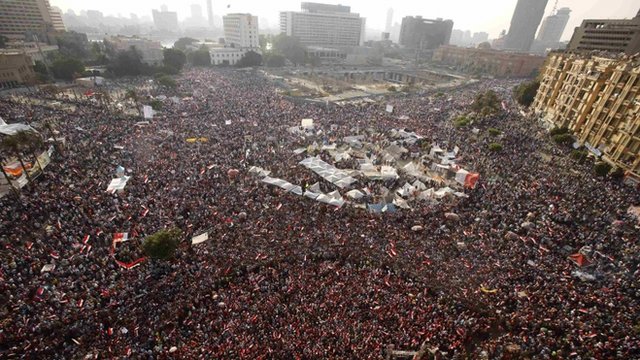
The solution to a crisis of democracy is often more democracy rather than less democracy. The protesters cheering the military helicopters that flew the Egyptian flag over Liberation Square are not much different from citizens across the world who tend to cheer every military coup until it is clear, too late, that military dictatorship is not the solution to the crisis of democracy. When the people come out to demonstrate en-masse, it is not the crisis of democracy but the actualization of democracy in practice, according to Norm Chomsky.


Morsi deserves the opposition that his administration has earned after one year of a do-nothing one-man rule for he failed to insist on the recall of the elected parliament. However, there is a danger of turning Egypt into Algeria by using the military to fight an elected government with disastrous results for the people. Morsi deserves to be supported to serve his full term as an elected President unless he is recalled in another election but he must stop serving alone: recall the elected parliament now and make sure that 50% of the ministers will be women and representatives of popular organizations! The army is right in pledging that they would not support any plan to subvert the secular constitution of Egypt but the military coup is untenable and must be reversed.


There is no guarantee that the president of the constitutional court, 68-year old Adli Mansour, who was imposed by the military to take over from Morsi will have a magic wand to resolve the democratic and economic crisis at the root of the protests and a new presidential election could still be won by Mr. Mossi or his allies unless his critics unite and campaign for the next election in three years. Mr. Mahmoud should defy the military and hand over back to Morsi who should recall parliament and include more women in government.

Every cook can govern, wrote C.L.R. James, following Lenin. This is because in a democratic election, whoever is elected is supported to serve the people and if the person is perceived to be failing the people, then there could be a recall election as was the case in the governorships of California (successful) and Wisconsin (unsuccessful, with some elected representatives defeated in the recall election) or the people could wait and elect a new chief executive and new legislative representatives at the next election. Having struggled for decades under military rule before being given the chance of electing a government of their choice for the first time, the people of Egypt should wait three more years to re-elect or throw out the candidates at the next election and put in a clause of term limits if they do not have one already. The authoritarian populism of the military is the good intention with which the road to hell is paved.


The African philosophy of non-violence should be the guide for the protesters and for the government in Egypt. The right to protest must be defended by the government while the people must support the democratic process instead of yearning for a dictatorship. Mob rule and individual rule were the extreme reasons why Aristotle preferred the system of aristocracy as a golden mean compared to the systems of democracy and monarchy but the Egyptians are not asking for mob rule nor for the rule of the individual, they appear to be all pro-democracy (supporters and opponents of Morsi alike) even if the opposition forces paradoxically see the military coup option as a facilitator of increased democratization while the supporters of the Morsi regime rightly insist on the right of the parties and individuals with the democratic mandate to serve their term of office. There is no need for clashing supporters and opponents to continue killing Egyptians on the streets.