Sunday, December 16, 2018

Jeyifo's Truthful Lie

By Biko Agozino

Many congratulations to Comrade Biodun Jeyifo on his very well-deserved Honorary D.Lit award from Obafemi Awolowo University, Ife. I liked the way he dedicated the award to the Talakawa or the masses (to whom he often dedicates his newspaper columns) and I applaud his promise of restitution to the suffering masses of Nigeria in his opening paragraph of the award-acceptance lecture. He highlighted the various crises facing universities in the country from the higher administration to the faculty union and to the students' union governments that appeared delegitimized. This may be a taste of interventions to come from the recently retired Harvard University Professor.

I took the prompt from his acceptance lecture to go and read again the acceptance lecture for the first such D.Lit by the great Ife, awarded to Chinua Achebe. I wished that Ife had not politicized a similar award to Soyinka two years after Achebe's award, forcing him to withdraw his name from consideration (to which the ignorant administrators said, good riddance, according to Jeyifo) just before Soyinka won the Nobel Prize and they went begging him to accept but he gave them waka shege, the Nigerian equivalent of the middle finger salute that is shown with all five fingers spread apart and thrust in the face of the target. I would have loved to read Soyinka's acceptance speech too.
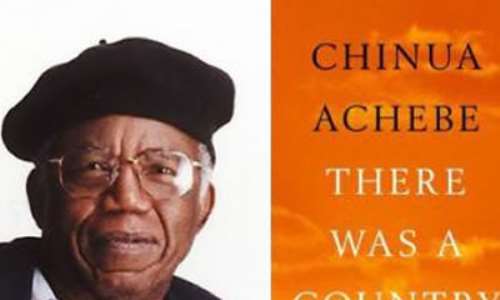
Image result for there was a country

 The Truth of Fiction by Achebe  is considered by Jeyifo to be the best essay by Achebe and it makes the speech of Jeyifo appear dumbed down in scholarly quality by contrast. The scholarly quality apart, Achebe was not really talking about Truth and Falsehood but about 'good and evil'. He spoke in a university that was renamed after a genocidist intellectual (three years after Achebe's lecture there) who, the year before Achebe gave his lecture,  publicly defended his wartime assertion that 'starvation is a legitimate weapon of war'. A journalist, Mr. Oparadike, had asked Awolowo during his 1983 Presidential campaign town hall press conference if he was prepared to address the concerns of those who felt aggrieved by the policy statement 13 years after the end of the war when the gruesomeness of the genocide was no longer in doubt? Awo said that he still stood by his statement and that he was indifferent to those who disagreed with him. Achebe was wondering how intelligent human beings could stoop to such a low level of morality in defense of evil and yet hardly any voice spoke up from the University of Ife in heroic defiance during and long after the genocide? 

That was what Achebe was addressing in his speech in which he also cited the epidemiological theory of a former minister for health in the Western Region who crossed over to AG from NCNC and went on to spear-head the foundation of the University of Ife. Dr. Sanya Onabamiro had written a book in which he had argued that the epidemics of childhood mortality was due to germs, parasites, and malnutrition and not due to witches. Opposed to him, Awo had published an essay in 1939 in which he claimed that Africans use juju as a science to kill one another by saying their names from a distance. This was apparently a rebuttal of Azikiwe who had called for the scientific method to be adopted by Africans in his 1937 Renascent Africa. Achebe sided with Zik in his lecture and dismissed claims by crazy preachers that the devil was to blame for man-made disasters such as genocide and childhood malnutrition. Jeyifo also indirectly sided with Azikiwe (without citing Zik and Awo) in his essays on 'How I survived Ebola' in which he rebuked STEM Professors for insisting on spiritual exorcism before they could occupy an official residence vacated by a colleague suspected of practicing occultism in the 21st century. A genocidist Nigerian army general, Obasanjo, also sided with Awo by calling on Africans to fight apartheid with juju.

It is strange that Jeyifo tried to equate the theoretical essay by Achebe with the claim of his friend, Professor Isola - alias the only honest man in the world - that his transfer from University of Lagos to University of Ife was motivated by the desire to join his friends in Ife and yet the friends were not yet at Ife by the time Isola went there. This mix-up of the dates in the mind of an old retired professor should not have been described as falsehood by Jeyifo. Perhaps Isola, the honest man, forgot the sequence of the events but he may have negotiated with the University of Ife that the condition for him to transfer was that they also try and lure his friends to Ife. Perhaps he was too modest to claim that he was the one who attracted his friends to Ife but such team-building is not unknown in academia. 

True or false, the memory of the Honest Man is not at the same level of the evil 'malignant fiction' that Achebe contrasted with the 'beneficent fiction' that tries to make the world better by imagining the sufferings of others instead of hanging on to the falsehood that men are better than women, that one race, class or caste is better than others, or that some speakers of a certain language are the source of all the troubles in the land, or that the Palmwine Drinkerd drank 150 kegs of palm wine every morning and 75 more kegs every evening to help him cope with the land of the ghosts. Some fictions like the square-root of minus one remain powerful in Mathematics despite being fictional, Achebe said. Perhaps he was suggesting that Nigerians should use the fiction of the Palmwine Drinkerd to try and curb alcoholism as a disease that kills many instead of celebrating it as a sign of macho manliness similar to the abuse of power by those who are power-drunk and who showed no compassion for the suffering of their fellow human beings while being applauded by what Soyinka metaphorized as the leftwing and the rightwing of the Cockroach.

Achebe concluded his lecture just as he started. Although he started by citing Picasso on the view that all art is false, he went on to state the fact that the painting of the civil war scene, Gurnica, by Picasso was banned by the fascist Franco dictatorship in Spain. Similarly, Achebe's novel, A Man of the People was published two days after the January 1966 coup and just because the novel ended with a coup, some people suspected that Achebe must have been among the coup plotters. Achebe turned the table on a university teacher who questioned him in 1974 by asking if he was in on the coup? Achebe asked the teacher if he had read the novel? He gave a vague answer. Achebe asked him if he also thought that the novelist planned all the corruption and violence that accompanied Opertation Wetie that took place in the novel, did the novelist also plan the counter-coup that was narrated in the novel? He said that it was excusable for soldiers (who could say that they did not have time to read novels) to go after him to seek to arrest him after the counter-coup but it was unacceptable for a professor to display the same ignorance about the truth of fiction.

Jeyifo, a Marxist theorist of the people and for the people, appears to have trivialized the enormity of the classic essay by Achebe by invoking the Afro-Cuban mythology of the mutual beheading of Truth and Falsehood in a fight and the adoption of the head of Falsehood by the body of Truth. The Cubans may just be referring to the historical materialist thesis that it is being that determines consciousness, and not consciousness that determines being. Such a statement does not come close to the eye-witness testimony against genocide by Achebe. It is sad that Jeyifo has consistently denied the genocide against the Igbo that Achebe was condemning by repeatedly and consistently describing it as 'alleged attempted genocide' in his serialized review of There Was A Country by Achebe. 

Hopefully, the call for restitution by Jeyifo in his opening paragraph would be extended to the 3.1 million mostly Igbo who were killed in Biafra without apology and without reparative justice. Let us hope that Jeyifo will spend his retirement advocating for the masses who were subjected to genocide in Biafra instead of equating their suffering with mythology. Even if mythology is a safe falsehood with which to indict genocidal regimes, the examples of Jeyifo's friends, Ola Rotimi (who published The Gods Are Not To Blame at the height of the genocide against the Igbo in 1968) and Soyinka who reflected on that genocide in 1975 (Death and the King's Horseman) should encourage Comrade BJ to abandon his long held genocide denialism and add his voice to those calling for justice. He has nothing to lose by examining what his comrade, Edwin Madunagu, has repeatedly denounced as the crass opportunism of the left during and after the Nigeria-Biafra war.

Monday, November 26, 2018

Chibok Girls: According to Obama and Jonathan


'I was horrified when, about six months after Malala’s visit, 276 Nigerian schoolgirls were kidnapped by the extremist group Boko Haram, seemingly intent on causing other Nigerian families to fear sending their daughters to school. It had prompted me, for the first and only time during the presidency, to sub for Barack during his weekly address to the nation, speaking emotionally about how we needed to work harder at protecting and encouraging girls worldwide.' Michelle Obama, Becoming.
Image result for becoming michelle obama tour
Top of Form


'Monday, April 15, 2014
01:00 Hours -
The notification came that heavily armed Boko Haram Islamists had arrived in open trucks and quietly abducted about two hundred girls from a boarding school in Chibok, Borno State in North-Eastern Nigeria, which is about two hours drive from Nigeria's border with Cameroon.' 
Jonathan, My Transition Hours. 


Front Cover

Oga Jona knew the exact hour but unlike Ms Obama, did not know exactly how many girls were kidnapped and was not sure exactly how far Chibok was from the border with Cameroon. Clueless?

A Professor cautioned me as follows: ‘Jonathan’s note is a diary entry on the day of the event. Nobody knew on the day of the event, and for quite a while after, exactly how many children were abducted, how many fled, how many died. Mrs. Obama’s is a recollection after the fact rather than a diary entry on the day of the incident. I’d say that explains the discrepancy. We all know now, if, indeed, we do, how many children were taken. Not to excuse Jonathan’s incompetence.’

I responded: ‘Bros, Jona still does not believe that any Chibok girl was kidnapped. He went on to suggest that the state governor arranged the whole thing as a scam, that even Chibok parents were not protesting until the US and Europe started pouring vitriol, that the principal of Chibok was promoted to Commissioner for Education, that the #bringbackourgirls were rewarded, that the first Chibok girls rescued were housed in govt house by the governor for weeks before being sent home with heavy pockets. Haba. What is he banging on about? He no dey shame?’

Professor again: ‘Biko you’re right. Problem, of course, is that when you consider his successor’s apparent lack of interest in the matter, it’s easy to see why the conspiracy theories have only grown stronger.’

I responded: True talk. Na the family of the mad man dey feel the shame. It is not an individual flaw.

A brother sympathizes with Jonathan: ‘the whole chibok girls issue was staged’
I responded:  The whole world is a stage.

Another brother intervenes: Prof, let's let the sleeping dog lie. It has become the responsibility of President Buhari to take care of this issue. If these girls were kidnapped where is the memo from the individual parents. I can't sit back and do nothing if my girls don't return. President GOODLUCK is a brave man when he relinquished power to Buhari regime who need to come up to speed.

I responded: Different issues you raise. My concern is that the ex President does not sound like someone in control when he used an estimated time to measure the distance to Cameroon when the actual distance can be specified by Google Maps. Ms Obama sounded like a commander in chief when she stood in for her husband. The problem of Jona is that of mediocrity. It would have cost him little to hire a professional editor to go over his wishy washy prose.

The brother changed the topic:  Obama and the wife were in power , did they do anything , just like they swiftly silenced Moumar Gadaffi of Libya, just thinking aloud.

I responded again to the brother: Still different issues from the intertextual reading of the two books published simultanously. Jona get Ph.D. but if he no sabi book, he could hire smart research assistants like you to ghost author for him. Abi na lie?

The brother attacked the straw man: What did Jona do to you, that his case is coming up now? Is it political? Can I get the books so I could get the gist and understand the big issue.

I responded: Bro …, Oga Jona no do me anything personally. You can buy his book and read it for yourself. He is entitled to his opinions but if he is not sure of his facts, then he should cite his sources for the readers to follow up. When he wrote that thousands of lives or hundreds of thousands of lives were lost in the civil war, I suspect that he is not good with research or he would have known that it was not soso thousands, it was millions upon millions, 3.1 million to be more exact, according to Herbert Ekwe-Ekwe. He could have cited sources to back up his understatement of the facts.

The brother concedes: I will agree with you, but don't be too harsh on him because he is writing on a subject alien to his area of specialization , the biological sciences. He actually has written a bad book! He may have to recall the publication, as a damage control effort, bet me.

I correct the brother, … na you be the harsh judge. How can you say that he has written a bad book if you are yet to read it? Even bad books deserve to be read and critiqued to make room for better books. Do not tell him to withdraw his book before you have read it for yourself o. For all you know, my critique of the book may be mistaken.
Bottom of Form


Thursday, November 8, 2018

Monday, July 16, 2018

Adaobi Tricia Nwaubani on Her Slave-Trading Grandfather

Adaobi Nwaubani narrates in the NewYorker the fact that there is hurt in every family that is self-inflicted. Having the humility to confess past wrongs and ask for forgiveness is part of the healing. Having the courage to forgive those who wronged you frees you from the resentment which Mandela called a poison that you take and hope that it kills your enemy. Desmond Tutu teaches that there is nothing that is unforgivable and there is no one who does not have something to be forgiven. Africans have forgiven the unforgivable crimes of 400 years of slavery, 100 years of colonization and 70 years of apartheid but some Africans still find it difficult to ask for forgiveness or to forgive members of their family for past wrongs. What Adaobi described is going on all the time in Igboland where the belief in witchcraft is not as pronounced as in some other cultures. Instead of hunting for witches to blame for your misfortune, the Igbo are encouraged to look inward and see if there are things that need atonement or to ask their Chi for a better deal. Adaobi's family did not kill or exile the adopted child of an enslaved ancestor but forgave him even after he was suspected of plotting to poison a leader of the family. Okonkwo was also told off by Achebe for killing Ikemefuna, a child that called him Papa, just because an oracle told him to do so. The Igbo have no history of raiding their neighbors for slavery or to execute genocide in order to colonize their land. They believe in letting the Eagle perch and letting the Kite perch. Egbe belu Ugo belu.


Igbo culture, like all cultures, is not perfect. Culture is not defined as a way of life, contrary to colonial anthropology. Culture is defined by Cabral, Ngugi, Hall and James as a struggle between the forces of domination and the forces of liberation. The way poor people live under capitalism, the way women live under patriarchy, and the way that black people live under racism is not the way they chose to live as a way of life but represent the conditions that they did not choose, conditions imposed by law and tradition, under which they struggle to make history. Osu and Ohu emerged among the Igbo as a consequence of 400 years of being raided as prey during the European trans Atlantic slavery that cost an estimated 100 million lives to Africa, according to Du Bois. The Igbo, unlike their neighbors, had no kings and chiefs, nor did they have standing armies to defend them against slave raiders and kidnappers or with which to raid their neighbors; and that was why they were the predominant group of people captured for sale from what Europeans called the slave coast, according to Douglas Chambers, Murder in Montpelier: The Igbo Africans in Virginia. Despite the blight of Ohu and Osu (outlawed by Azikiwe in the 1950s) on the egalitarian Igbo system of direct democracy, the fact remains that the Igbo survived the impacts of the slave raids, colonialism, and post-colonial genocide very remarkably. We are survivors, sang Bob Marley and the Wailers.

The question that Adaobi is raising is the old one of how could Africans sell their own into slavery? This was the question that Walter Rodney tackled in his doctoral dissertation on the History of Upper Guinea Coast. He concluded that what happened during the 400 years of the African holocaust was the process of class formation and primitive accumulation. The few chiefs who sold fellow Africans did not regard the war captives as their own people because they belonged to a different class or to a different nation. It was not a trade of the sort where parents put their own children on the shelf to say that these ones are toro-toro, those ones are shishi-shishi, and those other ones are nai-nai pence. It was a long-running war of pillage and the hunting of labor in black skin that Marx condemned in Das Kapital. It is true that some African elites benefited from the enslavement of Africans just as some African elites continue to benefit from the looting of African resources today but the vast majority of the Igbo and other Africans have always been activists against oppression and the main beneficiaries were Europeans from royal families down to pirates. The fact that the wounds of slavery are slow to heal in Igboland is evidence that the Europeans still owe reparations to the survivors of the European slavery. Adaobi's family is showing the way by apologizing to those they hurt in their family and asking for forgiveness from the ancestors. When will Europeans make atonement for crimes against humanity?

Another Guyanese writer, Karen King-Aribisala, posed the same Rodneyian question in her novel, The Hangman's Game, in which a Guyanese professor of linguistics who was married to a Nigerian and who lived under a brutal military dictatorship that was killing fellow Nigerians with impunity, posed the question in the novel: how could Africans sell their own for 400 years? In the novel, her Nigerian husband retorted by asking, how could she write a novel today about a slave rebellion and still make the enslaved lose instead of giving them victory in her fiction? She protested that it was a historical novel but her husband encouraged her to revise the history. The pain of the African Diaspora is real and sometimes I get it from students in the US or in the Caribbean, were you not those who sold us? To which I would answer that I would never have sold anyone, I would have been among the warriors and freedom fighters who did fight back with sticks and stones against guns to try and save us from being captured as Olauda Equiano narrated and as Rodney documented in historical accounts written by even some Europeans. 

Chinweizu, in The West and the Rest of Us, disputes the 419 propaganda by the British that they came to fight against slavery in Arochukwu and that that was why they burnt the Long Juju. Chinweizi said that that was not true because by that time, the slave trade that the British and other Europeans had initiated had come to an end and that the British were only after the trade in palm oil that they wanted to monopolize in order to dictate prices against the interests of the middlemen in the interior. It is true that there are always saboteurs and collaborators in any system of oppression especially one that lasted for more than 400 years but it is not smart to blame the survivors for the massive crimes against humanity committed by Europeans against Africans. Frantz Fanon said that Europe owes massive reparations to people of African descent at home and abroad. Chinweizu also agrees that reparations are due since people of African descent appear to be the only survivors of historic wrongs that have not been offered any form of reparations and not even apologies simply because of racism. 

Adaobi played into this by starting her opinion with a doubt as to whether Africans deserve reparations given that Africans, like all human beings, have also hurt one another. Africans never traveled thousands of miles to enslave others for 400 years and colonize the survivors for another 100 years and ridiculously turn round to say that Africans owe them billions, according to Ekwe-Ekwe in Africa 2001. In Specters of Marx, Derrida agreed that Africans deserve to have the unpayable international debts cancelled. It is time for Europe to start paying back the debts owed to Africa and the Caribbean countries are demanding such reparations from European enslavers. It is high time that the African states joined the demand for reparations even while recognizing that, like all human beings, we have also hurt ourselves in our struggle for survival and we should ask for forgiveness the way that Mathew Kerekou visited an African American church, knelt down and asked for forgiveness for the role of Dahomey in the capture and enslavement of fellow Africans..

The vexing question was posed repeatedly by Henry Louis Gates in his infamous documentary for the BBC, Wonders of the African World, where he asked market women in Ghana what it felt like to meet a descendant of one of those that her ancestors sold into slavery. Gates never asked a similar question to the white BBC crew or to any white person he met, how does it feel to work with the descendant of those that your ancestors enslaved? Many poor whites resent such questions and claim that they did not benefit directly from slavery even though they did benefit directly and indirectly from the national wealth created by slave labor. It was poor whites who were the crew of the slave ships, who fought the American civil war to keep slavery going, and it is poor whites who join the KKK and the police to terrorize the survivors of slavery today in defense of white privilege without knowing that they too pay the price for white supremacy since injustice anywhere is a threat to justice everywhere, according to Martin Luther King Jr. Reparations for slavery will not come out of the pockets of poor whites but would be paid as percentages of the GDP which would have gone to corporate welfare and not necessarily to the poor. Europeans and North Americans should follow the example of Adaobi's family and ask for forgiveness from Africans, they should offer reparations too.

Adaobi's family should go beyond the annual singing of Psalms for forgiveness and endow scholarships for the children of their estranged family descendants of the adopted Nwaokonkwo. Education is the key to lifting the poor from poverty. The reason why a widow died and her children died mysteriously could be due to infections in a country where the life expectancy is 50 years. Adaobi's cousin was right that this sounds like the story of the bogeyman with which naughty children are warned to eat their greens or else. Africans should invest more in research to find cures for tropical diseases instead of simply praying for forgiveness for past wrongs. Families that educate their sons and daughters to the highest levels tend to thrive better whether they are Ohu, Osu or Amaala. Education is the key to the healing of the wounds of slavery in Africa. 

With more emphasis on education for which the Igbo are the leading achievers in Nigeria, people like Adaobi will make friends with more school mates irrespective of their family backgrounds and Adaobi may learn the Igbo language enough to understand the meaning of names. Her family name, Nwaubani does not mean someone from the coastal area, it is the name of King Ja Ja of Opobo who rose from 'slavery' to become king over the community of his master to show that it was not really slavery and whose name was actually, JoJo Ubani or someone who was wealthy in real estates: Uba is wealth and Ani is land. Similarly, the name of the town that they changed, Umuojameze, does not mean that the oracle is king. On the contrary, it means that the children of the flute, Oja, know no king, Ama eze. It is the Igbo egalitarian philosophy that the Igbo know no king but it is understandable that after the military imposed chiefs on Igbo ommunitiues in 1976 under the dictatorship of Obasanjo, those who wanted to be kings might be embarrassed by a name that said that the Igbo know no king.

Biko Agozino

NB: The following opinion editorial in response to this blog post may interest some:


Biko

Wednesday, January 24, 2018

OBASANJO’S BLOODY FINGERS

By Biko Agozino

“The lice of poor performance in government - poverty, insecurity, poor economic management, nepotism, gross dereliction of duty, condonation of misdeed - if not outright encouragement of it, lack of progress and hope for the future, lack of national cohesion and poor management of internal political dynamics and widening inequality - are very much with us today. With such lice of general and specific poor performance and crying poverty with us, our fingers will not be dry of ‘blood’.” – Obasanjo


The press release by General Olusegun Obasanjo concerning the state of Nigeria is full of evasions and half-truths. It is not ‘lice’ that make the lousy ‘fingers’ of Obasanjo and his fellow genocidists ‘not to be dry of “blood”. Their fingers are dripping with fresh blood because the killings have continued unabated since the launch of the genocide against the Igbo who wisely voted massively against the Buhari regime that Obasanjo helped to impose.

For full disclosure, Obasanjo is expected to admit his complicity in the ongoing genocide and offer unconditional apologies to the Igbo in particular. He should join all well-meaning people to demand for atonement in the form of reparations. Obasanjo should admit that the gruesome killings by security forces, terrorists and herdsmen that he lamented follow the pattern of the genocide against innocent Igbomasses. Unless Nigerians admit and make atonement for this foundational genocide, the culture of genocidal violence will continue to wet the fingers of genocidist rulers with ‘blood’, according to the laws of karma.

However, despite all his human limitations and with all his involvement in crimes against humanity, Obasanjo remains exceptional for being the first head of state in Nigeria to hand over power to an elected successor and he did so twice though he has been accused of imposing flawed successors. He is also the first head of state to appoint more women to offices in his administration although some suspect that some of those women may wear the #MeToo pin against him.

He was able to settle the dispute with Cameroon over Bakassi without plunging Nigeria into a wasteful war with our African neighbors, though he could have better planned the resettlement of the Nigerians expelled from there or negotiated the admission of Cameroon to the opoen borders of ECOWAS. Similarly, Obasanjo had a magical way of resolving some political crises in other African states by, for example, persuading militarists to yield power back to civilians just as he persuaded Charles Taylor to step down in Liberia, though some suspect that he bargained corruptly with bags of public funds.

Despite the massive corruption in his administration, Obasanjo was and remains the only head of state to establish a special economic and financial crimes commission, EFCC, with which a sitting Inspector General of Police from his own ethnic group was convicted of corruption and jailed and some governors from his own party were indicted, though the EFCC under him allegedly went after mainly his perceived political opponents.

It is exceptional that apart from Dr. Nnamdi Azikiwe, Dr. Obasanjo is the only Nigerian head of state to publish books even if they were allegedly ghost-written for him by his research assistants; nothing stops other politicians from appointing their own research assistants. He is the only Nigerian head of state to initiate a presidential library even if the funding involved massive corruption by governors who donated public funds, according to Gani Fawehinmi. Obasanjo remains the only Nigerian head of state, with the exception of General Yakubu Gowon whose arranged Ph.D. yielded no publication so far, to recognize his own intellectual limitations and return to school to pursue an advanced degree.

Obasanjo is also the only former Nigerian head of state to call for Nigeria to beg 'agitators to stop' because there is enough cake to be shared. Obasanjo should go ahead and lead by example by offering a personal apology of his own and by calling on his fellow genocidist commanders to join him in offering reparations from their fabulous ill-gotten wealth. Obasanjo should call on Britain and Russia which facilitatedthe genocide against the Igbo to offer apologies and reparations to the Igbo too.

The call by Obasanjo for a Coalition of Nigerians is too little too late since he also recognized how crucial it is for Nigeria to be involved in the leadership of Africa. The coalition-building should involve all other states in Africa towards the United States of Africa that the first president of the country, Azikiwe, called for in 1959 and which Nkrumah and others echoed. With almost all Nigerians demanding the restructuration of the country, focusing exclusively on the internal colonial boundaries of Nigeria is unsatisfactory.

As Herbert Ekwe-Ekwe and Chinua Achebe remind us, the genocidal culture that was initiated against the Igbo in Nigeria has since spread throughout post-colonial Africa. Moreover, the African masses have transgressed the porous colonial boundaries in search of their daily livelihood in spite of heightened insecurities and genocidal threats. We need to recognize this reality and urgently build the Peoples Republic of Africa to guarantee the freedom of our people and collectively protect the masses against the imposed genocidist states ruled with blood-stained fingers across Africa.